<?xml version="1.0" encoding="UTF-8"?>
<?xml-stylesheet href="http://feeds.feedburner.com/~d/styles/rss2full.xsl" type="text/xsl" media="screen"?><?xml-stylesheet href="http://feeds.feedburner.com/~d/styles/itemcontent.css" type="text/css" media="screen"?><!-- generator="wordpress/2.3.1" --><rss xmlns:content="http://purl.org/rss/1.0/modules/content/" xmlns:wfw="http://wellformedweb.org/CommentAPI/" xmlns:dc="http://purl.org/dc/elements/1.1/" xmlns:feedburner="http://rssnamespace.org/feedburner/ext/1.0" version="2.0">

<channel>
	<title>be the story</title>
	<link>http://bethestory.com</link>
	<description>the blog about writing stories and being a better writer</description>
	<pubDate>Fri, 14 Nov 2008 20:11:46 +0000</pubDate>
	<generator>http://wordpress.org/?v=2.3.1</generator>
	<language>en</language>
			<atom10:link xmlns:atom10="http://www.w3.org/2005/Atom" rel="self" href="http://feeds.feedburner.com/BeTheStory" type="application/rss+xml" /><item>
		<title>Write Every Day: What Does that Mean &amp; Why?</title>
		<link>http://feeds.feedburner.com/~r/BeTheStory/~3/453326134/write-every-day-what-does-that-mean-why</link>
		<comments>http://bethestory.com/2008/11/14/write-every-day-what-does-that-mean-why#comments</comments>
		<pubDate>Fri, 14 Nov 2008 20:11:46 +0000</pubDate>
		<dc:creator>J. Timothy King</dc:creator>
		
		<category><![CDATA[writing]]></category>

		<category><![CDATA[writing life]]></category>

		<guid isPermaLink="false">http://bethestory.com/2008/11/14/write-every-day-what-does-that-mean-why</guid>
		<description><![CDATA[Jeff DeRego is no fan of NaNoWriMo. I can sympathize. What I can&#8217;t sympathize with is that he disses the idea of writing &#8220;every day.&#8221; Listen to his audio commentary for Paula B&#8217;s Writing Show. Here&#8217;s my audio response.
I agree with him on NaNoWriMo. I agree with him except on one point. I think writers [...]]]></description>
			<content:encoded><![CDATA[<p><a href="http://www.myspace.com/jrderegowriter">Jeff DeRego</a> is <a href="http://www.writingshow.com/podcasts/2008/11052008.html">no fan of NaNoWriMo</a>. I can sympathize. What I can&#8217;t sympathize with is that he disses the idea of writing &#8220;every day.&#8221; Listen to <a href="http://www.writingshow.com/podcasts/2008/11052008.html">his audio commentary for Paula B&#8217;s <em>Writing Show</em></a>. Here&#8217;s <a href="http://bethestory.com/wp-content/jeff_derego_response.mp3">my audio response</a>.</p>
<p>I agree with him <a href="http://bethestory.com/2008/02/29/why-i-dont-do-70-days-of-sweat-and-other-sprints">on NaNoWriMo</a>. I agree with him except on one point. I think writers do write every day. Maybe you don&#8217;t always write words for your novel, but you write something that isn&#8217;t email. Maybe it&#8217;s an article, or an editorial, or maybe it&#8217;s pre-writing for your novel. Or maybe &#8220;writing&#8221; just means planning on your novel&#8211;although I&#8217;d be very careful with that one, because &#8220;planning&#8221; can be a wonderful source of procrastination, which is <strong>not</strong> writing.</p>
<p>In short, I think it&#8217;s much more important to maintain a sustainable pace and to adopt an effective writing process. That said, I am <a href="http://bethestory.com/2008/10/25/nanowrimo-almost-here-and-do-i-have-a-surprise-for-you">doing NaNoWriMo this year</a>, but only because I just coincidentally happen to be starting a new book.</p>
<p>(And as it&#8217;s turning out, I&#8217;m probably not going to &#8220;win.&#8221; But that doesn&#8217;t bother me so much.)</p>
<p>-TimK</p>
<img src="http://feeds.feedburner.com/~r/BeTheStory/~4/453326134" height="1" width="1"/>]]></content:encoded>
			<wfw:commentRss>http://bethestory.com/2008/11/14/write-every-day-what-does-that-mean-why/feed</wfw:commentRss>

		<feedburner:origLink>http://bethestory.com/2008/11/14/write-every-day-what-does-that-mean-why</feedburner:origLink><enclosure url="http://feeds.feedburner.com/~r/BeTheStory/~5/453326135/jeff_derego_response.mp3" length="2535757" type="audio/mpeg" /><feedburner:origEnclosureLink>http://bethestory.com/wp-content/jeff_derego_response.mp3</feedburner:origEnclosureLink></item>
		<item>
		<title>How to Finish and Publish a Book</title>
		<link>http://feeds.feedburner.com/~r/BeTheStory/~3/444723193/how-to-finish-and-publish-a-book</link>
		<comments>http://bethestory.com/2008/11/06/how-to-finish-and-publish-a-book#comments</comments>
		<pubDate>Thu, 06 Nov 2008 20:36:04 +0000</pubDate>
		<dc:creator>J. Timothy King</dc:creator>
		
		<category><![CDATA[publishing]]></category>

		<category><![CDATA[self-publishing]]></category>

		<category><![CDATA[writing]]></category>

		<category><![CDATA[writing biz]]></category>

		<guid isPermaLink="false">http://bethestory.com/2008/11/06/how-to-finish-and-publish-a-book</guid>
		<description><![CDATA[Finishing the book&#8230;
A friend of a friend asked me the following questions:

I am writing a book. I have finished the first half and just need some editing and advice as to how to orient the story so I can complete the second part.

I would say, whatever else you do, finish writing the story. You can [...]]]></description>
			<content:encoded><![CDATA[<h3>Finishing the book&#8230;</h3>
<p>A friend of a friend asked me the following questions:</p>
<blockquote>
<p>I am writing a book. I have finished the first half and just need some editing and advice as to how to orient the story so I can complete the second part.</p>
</blockquote>
<p>I would say, whatever else you do, finish writing the story. You can always go back and edit afterward. Don&#8217;t let editing hold you up.</p>
<p>If you want specific advice on how to clean up your manuscript, you can pay a freelance story editor. (You&#8217;re looking for someone to do story editing, not line editing.) You want to find someone who works on the kind of story that you&#8217;re telling. You also want to start small, because you want to be able to get a feel as to whether you can work together, without risking a big chunk of money. And you want to work with someone who is sympathetic to how you want to publish your book and can give you advice in that context. (See below.)</p>
<p>Alternatively, you can get free advice from online and offline writers&#8217; groups. Online, there&#8217;s <a href="http://www.writingforums.com/">WritingForums.com</a> and <a href="http://fmwriters.com/">Forward Motion for Writers</a>. There are also local, offline writers&#8217; critique groups. Some of these you can find on meetup.com, on online writing forums, or by networking with other writers in your area. But remember that you get what you pay for. No one on a writers&#8217; forum or in a writers&#8217; critique group is going to read through your manuscript and critique it. They might be willing to critique a part of a chapter once in a while. And the quality of the critiques you get will vary; you&#8217;ll need to use your own judgment above all else.</p>
<p>Of course, you should use your own judgment anyhow, because this is your book, and you need to be comfortable with how its written. (Once you find a publisher, there are lots of war stories told about &#8220;negotiating&#8221; with the editor over the manuscript. But that&#8217;s a different topic.) The whole purpose of bringing someone else into the picture this early is to get experienced advice and ideas that you would not have thought of yourself. This helps you grow as a writer, but you still need to decide yourself whether to accept that advice. This becomes painfully obvious on online writing boards, where you may get three different critiques from three different people, each saying something completely at odds with the other two. <em>You</em> are the author. <em>You</em> need to choose. Because it&#8217;s <em>your</em> book, not theirs.</p>
<p>I should also add here that a mentor can be invaluable. Mentoring is a topic all its own. But one of the keys to maintaining a relationship with a mentor is not to overload her with questions. Your mentor is not your assistant. She is just there to help you understand conceptually where you might go. You need to do all the actual work, including finding and paying for a freelance editor, if that&#8217;s the path you want to take.</p>
<h3>Publishing the book&#8230;</h3>
<blockquote>
<p>I would appreciate any help or information you could give me along the way as to how to get this book published.</p>
</blockquote>
<p>There are basically 4 ways of publishing a book:</p>
<ol>
<li>
<p><strong>Sell your manuscript to a traditional, third-party publisher.</strong></p>
<p>This doesn&#8217;t necessarily mean a big publisher. There are lots of boutique publishers that sell niche titles. The publisher will help you edit your manuscript, bring it to market, and work out a marketing plan. You yourself will still have to do most or all of the actual marketing&#8211;it&#8217;s not like they show it on TV.</p>
<p>In order to convince a publisher to buy your manuscript, you need to develop contacts inside the book-publishing industry. You may need to find an agent. And you may need to keep trying for many years before you can convince a publisher to bite. At that time, the publisher will also want to feel that you can turn out a second and third book, and more, if your first book succeeds.</p>
<p>Holly Lisle has some excellent advice on getting published in the &#8220;writers&#8221; area of her site: <a href="http://shop.hollylisle.com/jamaffiliates/jrox.php?id=246&#038;jxURL=http://www.hollylisle.com/fm/">www.HollyLisle.com/fm/</a>.</p>
<p>A third-party publisher is good if you can get one and don&#8217;t want to set up your own indie press (see #2 below). Sometimes, an author will use a subsidy press (#3) or value-added printing service (see #4) as a stepping stone to catching the attention of a third-party publisher. (Note that in these cases, it&#8217;s the marketing and persistence of the author that gives him some level of success after self-publishing with a subsidy press, and that success is what catches the eye of the traditional publisher.)</p>
</li>
<li>
<p><strong>Start your own, independent publishing company.</strong></p>
<p>This is what I did. This strategy is sometimes called &#8220;self-publishing,&#8221; but I don&#8217;t like to use that term anymore, because &#8220;self-publishing&#8221; can also refer to strategy 3 below. Also, the term &#8220;self-publishing&#8221; has taken on a negative connotation in some circles, even though there are numerous famous (and successful) books that were self-published. So on Bob Baker&#8217;s advice, I call it &#8220;independent publishing&#8221; (similar to &#8220;indie&#8221; music labels).</p>
<p>Starting your own publishing company can get your book to market faster than going with a third-party publisher, because you don&#8217;t have to sell it to the publisher first. But this option also means you and you alone are responsible for making sure it&#8217;s salable, for learning all about what it takes to bring it to market, and for making it succeed. You need to be a writer, a business wizard, and a marketing expert, all rolled into one. There will also be people and companies in the book industry who will look down on you for &#8220;self-publishing,&#8221; and they may refuse to do business with you. So you have to factor that into your marketing plans.</p>
<p>If you want to start your own company, I highly recommend the book <em>Aiming at Amazon</em> by Aaron Shepard, for the business and publishing end of things. (See <a href="http://www.aaronshep.com/publishing/blog.html">Aaron Shepard&#8217;s publishing blog</a> for information on the upcoming new edition.) His marketing approach, however, is incomplete, because &#8220;sell my book on Amazon&#8221; is not a marketing strategy. Even if Amazon is the biggest single book store in the world, Amazon should still be the smallest piece of your marketing effort, because Amazon&#8217;s philosophy (as far as I can tell) goes something like: &#8220;Please send us all your products and your web visitors, so we can make lots of money.&#8221; And that&#8217;s not going to do you much good.</p>
<p>I recently discovered Bob Baker, and I&#8217;m turning into a huge fan of his indie-book marketing materials, because his mindset is almost identical to my own (which was honed on the teachings of Perry Marshall, Dan Kennedy, Ted Nicholas, and other direct-marketing gurus). Bob Baker&#8217;s &#8220;Full Time Author&#8221; site is an excellent place to start: <a href="http://FullTimeAuthor.com/">FullTimeAuthor.com</a>.</p>
<p>If you plan on publishing more than one book, and you plan on doing it yourself, then go this route. Take the time to learn the ropes and start your own company. If you only plan on publishing one book, such as if you&#8217;re publishing a memoir primarily for friends and family, consider using a subsidy press (#3) or value-added printing service (#4).</p>
</li>
<li>
<p><strong>Hire a subsidy press to publish your book.</strong></p>
<p>This is a compromise between options 1 and 2 above. It&#8217;s also a form of &#8220;self-publishing,&#8221; but not indie publishing, as I&#8217;ve used the term.</p>
<p>Subsidy presses used to be called &#8220;vanity presses,&#8221; and going with a vanity press used to immediately brand your book as worthless in the industry. That attitude has softened a bit. Still, as it is when you start an indie press, many people in the industry will look down on you and may refuse to do business with you if you hire a subsidy press.</p>
<p>Here&#8217;s how it works: You plop down a couple thousand dollars, and they provide a bundle of services. They might help you design a cover, for example, and go through the mechanics of manufacturing the book and getting it on Amazon and BN.com. They&#8217;ll also charge you a higher per-unit cost for copies your book than you could get using option 2, because the subsidy press is actually the publisher of record, and they&#8217;re the middle-man between the printing company and you.</p>
<p>A subsidy press will probably NOT be able to help you with marketing. Don&#8217;t do business with any company that makes wild marketing claims, such as saying your book will be in every bookstore in the country, in return for a few thousand bucks. In fact, be very careful with subsidy presses in general, because there are still a number of unscrupulous ones out there, who promise desperate writers the world and then can&#8217;t deliver, leaving the writers despondent and broke. Realize that hiring a subsidy press is <strong>not</strong> &#8220;getting your book published&#8221; in the traditional sense. With a traditional publisher, the publisher pays <em>you</em> to publish your book. (That&#8217;s what advances and royalties are.) With a subsidy press, you pay them (and then the two of you split the profits). Hiring a subsidy press is just that: you&#8217;re outsourcing part of the self-publishing process to a company who can do it cheaper and easier than you can. But you and you alone are the one responsible for the success or failure of your book.</p>
<p>Some people advise that you avoid subsidy presses completely, because (they say) the subsidy press is going to take your money and not provide you with anything you couldn&#8217;t do yourself. But that&#8217;s not necessarily true, because not all of us are business whizzes who have time to learn the ins and outs of the book industry. The subsidy press can handle the mechanics of many of these issues for you, which can be extremely valuable to someone who can&#8217;t do it himself but still wants to go the self-publishing route.</p>
<p>For a comparison between setting up an indie press and hiring a subsidy press, see the post <a href="http://bethestory.com/2008/10/08/how-much-does-it-cost-to-publish-a-book">&#8220;How Much Does It Cost to Publish a Book?&#8221;</a></p>
<p>A subsidy press is best if you plan on publishing a limited number of titles. For example, if you&#8217;re publishing your memoirs for friends and family or for vanity&#8217;s sake. Or if you want to publish a book to give out as a freebie at seminars you give or some such. A subsidy press can also be an option if you plan on building up a fan base in order to attract the attention of a traditional publisher.</p>
</li>
<li>
<p><strong>Use Lulu.com (or some other value-added printing service).</strong></p>
<p>Lulu is a strange animal in the book industry, strange enough to deserve its own entry. It&#8217;s a little like a subsidy press in that you pay them money for services. They even have a &#8220;distribution&#8221; service via which they&#8217;ll buy you an ISBN and get your book on Amazon. And you can even publish it under your own name. (That is, your company can be listed in the space under &#8220;publisher,&#8221; instead of the publisher being listed as &#8220;Lulu.&#8221;)</p>
<p>But Lulu provides fewer services than a subsidy press. They&#8217;re more like a print-on-demand printing company, except they do business with authors directly (not with publishers, as most printers do), and as a result, they provide a slightly different service model. Their per-unit prices are also substantially higher than a print-on-demand printer, for the same reasons a subsidy press charges you more for copies of your book.</p>
<p>Amazon&#8217;s <a href="http://www.createspace.com/">CreateSpace</a> is similar to Lulu, but offers a slightly different set of services. They&#8217;re also an alternative if you want to go this route to publishing.</p>
<p>As with a subsidy publisher, you and you alone are responsible for the quality, marketing, and success or failure of your book. You&#8217;re just outsourcing part of the process to a third party. Except that with Lulu and CreateSpace, you&#8217;re outsourcing less of the process than with a subsidy publisher.</p>
<p>And like a subsidy press, value-added printing services are best if you plan on publishing only a limited number of titles, because it&#8217;s more expensive in the long run to publish with Lulu or CreateSpace than it is to start your own indie press. And like a subsidy press, you can also use these services to build up a fan base in order to attract the attention of a traditional publisher.</p>
</li>
</ol>
<p>I hope this gives you some idea of what book publishing is like. Of course, this just scratches the surface. For even more information, check out the <a href="http://www.writingshow.com/">the podcast episodes and articles at <em>The Writing Show</em> (WritingShow.com)</a>.</p>
<p>Good luck in whatever you decide to do.</p>
<p>Sincerely,<br />
-TimK</p>
<img src="http://feeds.feedburner.com/~r/BeTheStory/~4/444723193" height="1" width="1"/>]]></content:encoded>
			<wfw:commentRss>http://bethestory.com/2008/11/06/how-to-finish-and-publish-a-book/feed</wfw:commentRss>
		<feedburner:origLink>http://bethestory.com/2008/11/06/how-to-finish-and-publish-a-book</feedburner:origLink></item>
		<item>
		<title>NaNoWriMo almost Here, and Do I Have a Surprise for You</title>
		<link>http://feeds.feedburner.com/~r/BeTheStory/~3/431964624/nanowrimo-almost-here-and-do-i-have-a-surprise-for-you</link>
		<comments>http://bethestory.com/2008/10/25/nanowrimo-almost-here-and-do-i-have-a-surprise-for-you#comments</comments>
		<pubDate>Sat, 25 Oct 2008 19:31:23 +0000</pubDate>
		<dc:creator>J. Timothy King</dc:creator>
		
		<category><![CDATA[writing]]></category>

		<category><![CDATA[writing life]]></category>

		<guid isPermaLink="false">http://bethestory.com/2008/10/25/nanowrimo-almost-here-and-do-i-have-a-surprise-for-you</guid>
		<description><![CDATA[I never do NaNoWriMo, because I believe if you&#8217;re a writer, you should write. Period. One month of excitement is not going to change your life. It&#8217;s like one of those one-day self-help seminars. You go; you have an enlightening, emotional experience; you feel good about yourself and your future; and three days later, you&#8217;re [...]]]></description>
			<content:encoded><![CDATA[<p>I never do NaNoWriMo, because I believe if you&#8217;re a writer, you should write. Period. One month of excitement is not going to change your life. It&#8217;s like one of those one-day self-help seminars. You go; you have an enlightening, emotional experience; you feel good about yourself and your future; and three days later, you&#8217;re back to being your old self. NaNoWriMo always seemed to me to be like that. One month of hard-core writing, followed by&#8230; what? If you&#8217;re a writer, you write, year-round. You don&#8217;t cram it all into the month of November. I have held this position for years.</p>
<p>However, I am participating in NaNoWriMo this year. <a href="http://www.nanowrimo.org/eng/user/425611">Here&#8217;s my NaNoWriMo user page.</a></p>
<p>Why the change? Actually, no change. It just so happens that I&#8217;m almost ready to begin working on Volume 2 of <em>The Conscience of Abe&#8217;s Turn: The Birth of the Conscience</em>. This is a sequel to <a href="http://abesturn.com/book1">the first book in the series</a>. And I plan to use Agile Storytelling to complete it as quickly as possible. I don&#8217;t know whether I&#8217;ll finish the whole book before the end of November, but I&#8217;m hoping I&#8217;ll complete 50,000 words worth (about half the book).</p>
<p>The whole idea behind Agile Storytelling is to adopt a set of practices that make it easy to quickly write a passable story. This works, because you do things in an order that helps you organize your thoughts quickly, and you also avoid writing a lot of prose that you&#8217;ll later need to throw out. You make all the big changes up front, and then the bulk of the writing proceeds smoothly. I&#8217;ve already tried the technique, in a limited way, while writing the short story &#8220;Recovery, Relapse, Relationship,&#8221; one of the extra chapters in <a href="http://abesturn.com/book1"><em>Abe&#8217;s Turn</em> Volume 1</a>. (My dad said it was the best thing I&#8217;ve ever written. Nice of him to say.)</p>
<p>I&#8217;ll post more about my experiences with Agile Storytelling here as I work on the next volume.</p>
<p>-TimK<!--break--></p>
<img src="http://feeds.feedburner.com/~r/BeTheStory/~4/431964624" height="1" width="1"/>]]></content:encoded>
			<wfw:commentRss>http://bethestory.com/2008/10/25/nanowrimo-almost-here-and-do-i-have-a-surprise-for-you/feed</wfw:commentRss>
		<feedburner:origLink>http://bethestory.com/2008/10/25/nanowrimo-almost-here-and-do-i-have-a-surprise-for-you</feedburner:origLink></item>
		<item>
		<title>You Are Worth Every Word You Write</title>
		<link>http://feeds.feedburner.com/~r/BeTheStory/~3/418303627/you-are-worth-every-word-you-write</link>
		<comments>http://bethestory.com/2008/10/12/you-are-worth-every-word-you-write#comments</comments>
		<pubDate>Sun, 12 Oct 2008 04:43:57 +0000</pubDate>
		<dc:creator>J. Timothy King</dc:creator>
		
		<category><![CDATA[writing]]></category>

		<category><![CDATA[writing life]]></category>

		<guid isPermaLink="false">http://bethestory.com/2008/10/12/you-are-worth-every-word-you-write</guid>
		<description><![CDATA[I know I&#8217;ve been away for a while, because I&#8217;ve been in the midst of the frantic throes of releasing my new novel, The Conscience of Abe&#8217;s Turn and my dad John King&#8217;s memoirs, Can You See God in This Picture. (We sold out of the latter on the day of its release, but I [...]]]></description>
			<content:encoded><![CDATA[<p>I know I&#8217;ve been away for a while, because I&#8217;ve been in the midst of the frantic throes of releasing <a href="http://abesturn.com/">my new novel, <em>The Conscience of Abe&#8217;s Turn</em></a> and <a href="http://canyouseegodinthispicture.com/">my dad John King&#8217;s memoirs, <em>Can You See God in This Picture</em></a>. (We sold out of the latter on the day of its release, but I have more on the way.)</p>
<p>Releasing <em>Abe&#8217;s Turn</em> has taught me something. I need a lesson in humility. Not a lesson in how to be humble, but a lesson in how to admit when I&#8217;m good enough. You wouldn&#8217;t think a guy like me, who absolutely hates to admit that he&#8217;s ever wrong, would need that. But (like Dad), I&#8217;ve always doubted my own ability, always been plagued by feelings of inferiority, and usually for no good reason. That&#8217;s death knell to the working writer.</p>
<h3>Fear is the mind-killer</h3>
<p>Once when I was a little kid, probably about the age of my youngest daughter, I performed in church, sang a special song with my brother, if I remember correctly. Afterward, we stood near the back of the sanctuary, and as people made their way out, they shook our little hands and looked down at us and complemented us on how much they enjoyed our little song. Once the line of people had passed us by, I had a great idea. Let&#8217;s move closer to the exit, I told my brother, because then all those people would have to pass by us again and complement us again, and we&#8217;d get more praise for our performance.</p>
<p>Silly boy. Scary in an adult. Was I headed down the path that turns good men into &#8220;cult leaders&#8221;? (This is the term Sylvie Fortin used in part 2 of her excellent <a href="http://www.internetmarketingsins.com/"><em>Internet Marketing Sins</em></a>.)</p>
<p>I was not to become a cult-leader, fortunately. Unfortunately, somewhere in between boyhood and adulthood, I grew scared of myself, scared of success, scared of failure. I didn&#8217;t feel good enough. I know intellectually that I am good enough, because otherwise what were all those years of practice, critiques, and improvement for? I&#8217;m good enough, I&#8217;m smart enough, and&#8211;doggone it&#8211;people <em>like</em> me! Truly, it&#8217;s a great feeling to have another writer tell you that he aspires to write something like what you&#8217;ve written. But no matter how much I write, and no matter how much positive feedback I receive, I still fear sending my work out into the world, where it can actually change what people think of me.</p>
<p>I didn&#8217;t want my friends and family to read <em>Abe&#8217;s Turn</em>, because <a href="http://www.goodreads.com/book/show/4715747.The_Conscience_of_Abe_s_Turn_The_Birth_of_the_Conscience">as one reviewer noted</a>, &#8220;this book will prove to be highly controversial by many,&#8221; and I didn&#8217;t want my friends and family to look down on me for writing something they disliked due to its controversial nature. As it turns out, that&#8217;s a pretty silly fear, because my friends and family continue to love me, no matter what I write, even if they disagree with me. On the contrary, probably the very fact that <strong>I</strong> wrote it will make them want to find some rationalization for accepting it, even if they do disagree. Silly fear, keeps you from realizing your potential.</p>
<p>Fear is the mind-killer.</p>
<p>I don&#8217;t think I would even have made it through if it weren&#8217;t for <a href="http://bethestory.com/2007/04/06/the-lake-house-top-10-review"><em>The Lake House</em></a>. Remember the last scene of <em>The Lake House</em>, when Kate figured out what happened to Alex and why he had never made it to dinner that night? Suddenly, her life had only one goal, one focus, to get a message to Alex, to warn him. She allowed no obstacle, no distraction, no fear to slow her down. She took on what Dan Kennedy calls &#8220;a sense of urgency,&#8221; which is a key to success. So whenever I found myself holding back, I just remembered <em>The Lake House</em>: Sense of urgency. No time to be cautious. You slow down, you die.</p>
<p>There&#8217;s a difference between humility and fear. Humility knows its own limits, but fear imposes them. You can still stretch yourself beyond your current limitations, in humility, but only if you have the courage to do so.</p>
<h3>Mindset is the fear-killer</h3>
<p>Fear doesn&#8217;t go away with more and more successes, because you&#8217;re constantly trying new things and experiencing new failures and new successes. You&#8217;ll never know whether new experiments will succeed until after you try them, and in the back of your mind resides the fear that they will be failures.</p>
<p><a href="http://m171.infusionsoft.com/go/renaissance/timk/">Perry Marshall in his <em>Marketing Letter</em></a> wrote last year about when his 11-year-old son Marcus faced a ropes course at a father-son camp. (I mentioned Perry in the <a href="http://blog.jtimothyking.com/2008/07/25/friday-snippet-the-preface-to-abes-turn">acknowledgments to <em>Abe&#8217;s Turn</em></a>.) When Marcus got two steps across the tightrope, he froze, afraid of heights. Finally, one of the camp counsellors showed him how far he would fall if he lost his balance. There wasn&#8217;t even enough slack in his harness for him to sit down on the rope, never mind <em>fall</em>. That gave him the confidence to inch his way across. Held up a lot of other campers. But he finally made it all the way through the course.</p>
<p>Perry summed up the lesson:</p>
<blockquote>
<p><em>You&#8217;re going to confront this same Black Wall of Fear at every important transition of your life. You will <u>always</u> question your sanity and you will always wonder, at some level, if the bottom is going to fall out&#8230;</em></p>
<p>Dear friend and subscriber, I only know of ONE way to defeat that black Wall of Fear.</p>
<p><strong>Punch your fist right through it and <em>drive on</em>.</strong></p>
</blockquote>
<p>Indeed, punching through the Black Wall of Fear can even be an invigorating experience. I&#8217;m actually looking forward to giving interviews now, whereas I was terrified of the prospect before.</p>
<ol>
<li>
<p>It doesn&#8217;t matter if you fail occasionally. In fact, you can expect to fail. Interest in <em>Abe&#8217;s Turn</em> is less than I originally expected. People have liked the series, but it&#8217;s been hard to convince them to give it a chance, even those in its direct target market. Now I&#8217;m looking at a backup plan that will allow me to build a more enthusiastic fan-base for the series over a longer timeframe (because easy-come easy-go, but fans that stand the test of time are more loyal). On the other hand, we sold out of Dad&#8217;s book the first day. Practically everyone we asked wanted a copy, and there are lots more people on our mailing list who probably also want a copy.</p>
</li>
<li>
<p>Know what you&#8217;re getting into, and plan alternatives. Publishing the two books was actually the easy part, because I knew the technology and what might go wrong. I knew that the book came out okay, because I had printed a proof before going into full production. I knew that if it took a month for it to appear on Amazon, that&#8217;s no problem, because I wasn&#8217;t depending on Amazon to fulfill initial sales. The hard part is&#8211;and always will be&#8211;marketing and publicity. How to get noticed? How to turn notice into sales? It&#8217;s hard even if you do everything right. But there are dozens of ways to market your book, and dozens of ways to get noticed. Alternatives. Still, what happens if I run out of money. Well, there&#8217;s always software development, and I&#8217;m a damn good, veteran software developer. Alternatives.</p>
<p>But what if the economy tanks? That&#8217;s a whopper of a question. But the answer is still the same: education, alternatives. There&#8217;s always someone who makes money in a so-called &#8220;bad&#8221; economy. What alternatives are most likely to thrive in your niche or market during the &#8220;bad&#8221; economy? (Recently, I read a press release by a company who helps people collect on civil court judgments. It sounded like they&#8217;re planning for a big upswing in business.)</p>
</li>
<li>
<p>The ultimate weapon against fear is to change one&#8217;s mindset, to transcend fear. Steve Pavlina talked about this in his <a href="http://www.stevepavlina.com/blog/2005/12/stevepavlinacom-podcast-008-overcoming-fear/">podcast about overcoming fear</a>. When I was looking for websites on which to publicize my book, I occasionally froze, because what if they&#8217;re not interested? I was afraid of being rejected. But what&#8217;s the worst that could happen? Nothing. I would be in the same situation as if I had not even asked. Does that reflect on me? No, it reflects on them. It&#8217;s <em>their</em> choice, not mine. Indeed, some did reject me, because they weren&#8217;t interested in &#8220;self-published works.&#8221; But that&#8217;s okay, because my alternative was to spend another 10 years being rejected by publishers, and that was something I had already decided not to do.</p>
<p>(By the way, unlike some self-published authors, who are just trying to get the attention of a third-party publisher, I am actually trying to succeed. By the time a third-party publisher approaches me wanting to publish my work, I&#8217;m not going to need them anymore. There are some websites, for example, like <a href="http://goodreads.com/">GoodReads.com</a>, who are right now developing a bond of trust with me. There are others who are shunning me and will therefore miss out on what I have to offer, probably forever in the future. That&#8217;s okay. My business model does not actually depend on them. It doesn&#8217;t even depend on Amazon, actually.)</p>
</li>
</ol>
<h3>But what if I write something that turns out to be crap?</h3>
<p>So what if you do?</p>
<p>This is possibly an author&#8217;s greatest fear. It doesn&#8217;t matter how much you&#8217;ve written, how many accolades you&#8217;ve received, or how many stories you&#8217;ve published. As long as you continue to stretch yourself, you will be trying new things, and you will fear having written crap.</p>
<p>I certainly have written <a href="http://www.jtimothyking.com/stories/department-caffeinated-beverages">stories I think read like crap</a>, <a href="http://www.jtimothyking.com/stories/in-the-past">stories I think feel like crap</a>, and even <a href="http://www.jtimothyking.com/stories/children-and-toilets">a story about crap (&#8221;Children and Toilets&#8221;)</a>. And still, I&#8217;m stupid enough to post them on my website, hold them up as examples of my work. What kind of an idiot am I?</p>
<p>On top of that, no matter how good you are, someone&#8217;s going to be nice enough to tell you that you got such-and-such plot device wrong, or they didn&#8217;t understand your character&#8217;s motivation, or they think your prose stinks. When I posted <a href="http://blog.jtimothyking.com/2008/09/05/friday-snippet-recovery-relapse-relationship">a snippet of a short story that takes place in Abe&#8217;s Turn</a>, a story that my father told me was one of the best things I&#8217;ve ever written&#8211;and I believe him&#8211;someone was nice enough to comment on the snippet to tell me that I had screwed up a plot device, that if my character really had Malignant Hyperthermia, she would have died. (Maybe, but the point of the story is that the doctor got to her just in time. In any case, it&#8217;s too late to change it now.)</p>
<p>I&#8217;ve been as opinionated myself, and I still am. Wait till I tell you about a classic best-selling Danielle Steele novel I just finished. It was great, until she got to the place where the characters started doing stuff that made no sense. Oh, and the little girl, supposedly 12 years old, talked like she was 6. How stupid is that?</p>
<p>So when I say that Danielle Steele just has way too much touchy-feely goo in between her paragraphs, because her characters are always thinking about how they feel, and they always feel the same way, and would she <em>just get on with the story already?!</em>&#8211; If Danielle Steele has any intelligence at all, she&#8217;ll ignore me. Or better even yet, swear to God that <em>I</em> should shove it up <em>my</em> story, and see how I like <em>that</em>. Because her readers swoon over all that gooey crap.</p>
<p>The thing you have to remember about critics is that their job is <strong>not</strong> to be fair. It is to appeal to their readers. So ignore them. Ignore me!</p>
<p>(The novel is <em>Safe Harbour</em>, and I rated it 4.5/5 stars, because I liked it enough that I know I&#8217;m going to be reading it again. Yes, I hated the gooey, boring way all the characters were always thinking about their feelings. But I loved the characters themselves. I actually felt myself passionately sympathizing with them, and I couldn&#8217;t help myself. So yeah, the critic in me is an idiot.)</p>
<h3>The more I think about it, the more I think there&#8217;s only one thing that really matters about what you write.</h3>
<p>Okay, two things, actually. The first is: do <em>you</em> like what you wrote? Do you love your characters as much as you expect others to? Do you think of them as real people, and do you dream of the life they lead, as if it were part of your life? When you pick up your book, do you have an inner desire to read it from cover to cover? When you finish it, do you feel a sense of loss, because it&#8217;s over? You&#8217;re never going to satisfy everyone, but can you satisfy yourself? If not, maybe it&#8217;s time to go back to the drawing board.</p>
<p>Secondly, marketing and celebrity are much more important than the quality of your writing. You need to be a competent writer, yes. But all of that competence will never be seen by anyone, unless you know how to market your work.</p>
<p>The point I&#8217;m trying to make, perhaps clumsily, is that you are worth every word you write.</p>
<ul>
<li>You are qualified to write, because you&#8217;ve worked hard to develop the skills you have.</li>
<li>If you aren&#8217;t getting published, it&#8217;s probably not because your writing is crap, because plenty of crap gets published; it&#8217;s because you haven&#8217;t made the contacts you need in the publishing industry.</li>
<li>If critics criticize you, that&#8217;s just their job. You can&#8217;t let it make you think you&#8217;re less of a writer. (In fact, the first time you&#8217;re lambasted publicly by a critic, you can take heart that you have finally arrived; you are a <em>real</em> writer, because you&#8217;ve moved someone enough to make him feel like he needs to tell everyone how much he hates your work.)</li>
<li>You can&#8217;t let self-doubt and fear freeze you. Keep learning. Keep exploring new alternatives. Know what you&#8217;re getting into. And then go forward.</li>
</ul>
<p>Keep writing!<br />
-TimK</p>
<img src="http://feeds.feedburner.com/~r/BeTheStory/~4/418303627" height="1" width="1"/>]]></content:encoded>
			<wfw:commentRss>http://bethestory.com/2008/10/12/you-are-worth-every-word-you-write/feed</wfw:commentRss>
		<feedburner:origLink>http://bethestory.com/2008/10/12/you-are-worth-every-word-you-write</feedburner:origLink></item>
		<item>
		<title>How Much Does It Cost to Publish a Book?</title>
		<link>http://feeds.feedburner.com/~r/BeTheStory/~3/444699929/how-much-does-it-cost-to-publish-a-book</link>
		<comments>http://bethestory.com/2008/10/08/how-much-does-it-cost-to-publish-a-book#comments</comments>
		<pubDate>Wed, 08 Oct 2008 21:49:33 +0000</pubDate>
		<dc:creator>J. Timothy King</dc:creator>
		
		<category><![CDATA[self-publishing]]></category>

		<category><![CDATA[writing biz]]></category>

		<guid isPermaLink="false">http://bethestory.com/2008/10/08/how-much-does-it-cost-to-publish-a-book</guid>
		<description><![CDATA[This post was originally posted at my personal blog.
A friend of mine emailed and asked:

If you don&#8217;t mind me asking, how much did it cost you to publish your book (or your dad&#8217;s)? You seem to be doing all of the important things that subsidy presses do and probably at considerable savings.

I&#8217;m still refining my [...]]]></description>
			<content:encoded><![CDATA[<p><em>This post was <a href="http://blog.jtimothyking.com/2008/10/08/how-much-does-it-cost-to-publish-a-book">originally posted at my personal blog</a>.</em></p>
<p>A friend of mine emailed and asked:</p>
<blockquote>
<p>If you don&#8217;t mind me asking, how much did it cost you to publish your book (or your dad&#8217;s)? You seem to be doing all of the important things that subsidy presses do and probably at considerable savings.</p>
</blockquote>
<p>I&#8217;m still refining my publishing process, and I don&#8217;t intend to publish many books by other authors (which is more expensive than publishing my own books, because you have to coordinate between two people, rather than just between the two sides of my own brain). But here&#8217;s what I&#8217;ve found out so far:</p>
<ul>
<li>
<p>I didn&#8217;t keep track of how much it cost (in hours spent) to edit and lay out my dad&#8217;s book. It wasn&#8217;t cheap, and I also found that adding changes after layout took a long time, because I had no good process for integrating those changes. So if I were to go through that again, I would first define a process for submitting changes to a manuscript that has already been laid out.</p>
<p>In general, I could easily see it costing $200 or more to hire someone to lay out a book, assuming it was already in electronic format and fairly well organized. No, I didn&#8217;t have to pay for someone to do that, because I had the technical wherewithal to do it myself. But the opportunity cost was that I could not do other things with my own time while I was hacking with Dad&#8217;s layout.</p>
<p>This is usually not an issue for me, however, because when I write my own books, I write them already laid out, so there&#8217;s almost zero layout cost. (Or rather, it would cost me more just to describe what I wanted to a third party than just to do it myself.)</p>
</li>
<li>
<p>The cover design for Dad&#8217;s book <a href="http://shop.jtimothyking.com/product/9780981692517"><em>Can You See God in This Picture?</em></a> my brother Josh put together. We used images from my dad&#8217;s archives. I gave Josh guidelines to use in designing the cover, based on my marketing knowledge, because a book&#8217;s front cover is its own advertisement. But we did zero market testing on Dad&#8217;s cover. For <a href="http://shop.jtimothyking.com/product/9780981692500"><em>The Conscience of Abe&#8217;s Turn</em></a>, I used a process that can be applied to any title. I used <a href="http://www.istockphoto.com/">stock photos from iStockphoto</a>, and I ad-tested the cover image and wording, even before designing the cover.</p>
<div style="float: right; margin: 1em">
<div style="margin: 0; border: 1px solid #888; padding: 5px; background: #fff; font-size: 85%"><a href="http://abesturn.com/book1" style="color: black"><span style="font-size: 150%; text-decoration: underline; color: #00f">Living in a Police State</span><br />Every government needs a conscience<br />to keep it honest. An online drama.<br /><span style="color: #080">AbesTurn.com</span></a></div>
<div style="margin: 0; text-align: center; font-size: 80%; font-style: italic">The winning ad</div>
</div>
<p>For the front cover wording, I ran text ads on the Google content network (those &#8220;Ads by Google&#8221; you see everywhere). I tried different keywords and phrasings to try to determine which ones resonated with my target market. This became &#8220;Living in a Police State&#8221; on the front cover and &#8220;Every government needs a conscience to keep it honest&#8221; on the back. While these ads were not expensive, I did spend close to $300 on them.</p>
<p>To choose the image, I started with &#8220;XSmall&#8221; size images for each candidate cover image, at $1 for each different image. I used these to create image ads, which I ran on my own websites. Each ad had the same wording on it, but a different picture. Then I drove traffic to those web pages and measured the click-through rate of each image ad. (I could have spent a lot of money on these ads if I had run them on other sites as well, much more than I had on the text ads, and that might have been money well spent, but I didn&#8217;t have the cash to invest at the time.) Two images tied for the greatest click-through. I chose one to be <a href="http://www.istockphoto.com/file_closeup.php?id=1222869">the cover image for <em>The Conscience of Abe&#8217;s Turn</em></a>, and bought a Medium ($5) or Large ($10) size image with which to create the cover design.</p>
<p>Now, while most subsidy publishers will design a cover, they&#8217;re probably not doing any ad testing. Probably not even any focus-group testing. If you can&#8217;t afford real market testing, however, I&#8217;d at least mock up the cover of a book and show it to my friends before committing to the design. (In fact, I&#8217;m planning to post a little YouTube video to try to drum up opinions on the cover for an upcoming small book. Not anywhere near as good as ad testing, of course, but it&#8217;s probably better than flying blind.)</p>
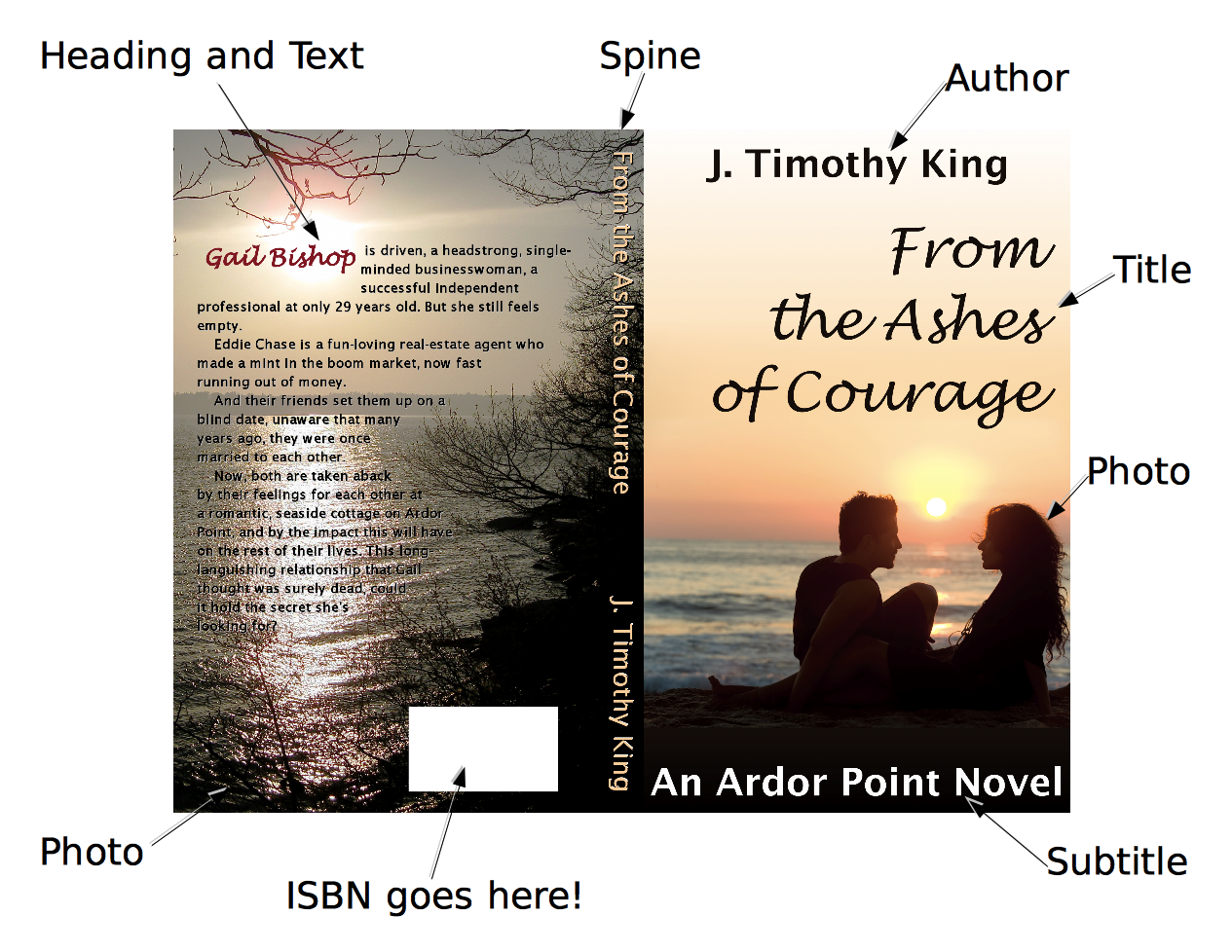
<p>Laying out the cover for <em>Abe&#8217;s Turn</em> is something I would in future contract out in a heartbeat, if I had the money to invest, because it&#8217;s a pretty complex cover. Simpler covers are pretty easy to put together, if you have and know how to use the software. (I believe Josh used Adobe Illustrator. I used the Gimp.) I created a mock-up of a cover for an upcoming book <em>People Stories</em>, and did it very quickly, because it was just a stock image, front-cover text, back-cover image, back-cover text, and white ISBN block (where the ISBN eventually goes), and maybe some spine text. For the <em>Abe&#8217;s Turn</em> cover, start with the fact that the original stock photo was not big enough for the cover, so I had to extend the dark bars in 3 directions through graphic manipulations. Then you go from there. Way more complex. Way more expensive. You could spend $100 to $1000 and up on a cover design, once you know what elements should be on it.</p>
</li>
<li>
<p>I started a publishing company, not a big one, just big enough for me. That means buying a block of ISBN&#8217;s. A block of 10 ISBN&#8217;s costs $275&#8211;grossly overpriced, yeah, but that&#8217;s what you get with a government-enforced monopoly. (I understand you can get a single ISBN for $125, but it hardly seems worth it if you plan on publishing multiple books. And if you only plan on publishing one book, you&#8217;re probably better of with a subsidized publisher or using Lulu&#8217;s distribution service.) And when you &#8220;apply&#8221; for an ISBN, you have to know what you&#8217;re doing, or else you&#8217;ll fall prey to all the useless offers Bowker makes, like trying to sell you barcode images that you can get for free elsewhere.</p>
</li>
<li>
<p>I used Lulu to print up advanced copies. Lulu is much more expensive than dealing with the printer directly, but their system is completely automated and fast, and you can make changes for free. So it&#8217;s good to try things out with, but a 208-page 6&#215;9&#8243; trade paperback costs $8.69 + shipping &#038; handling (which ain&#8217;t cheap). (Compare the Lightning Source price below.) I included this &#8220;Advanced Copy&#8221; step both with <em>Abe&#8217;s Turn</em> and with <em>CYSGiTP</em>, but I plan to skip it with my next title, because it doesn&#8217;t seem to add anything once I&#8217;m confident that I know what I&#8217;m doing.</p>
</li>
<li>
<p>I use Lightning Source for printing, which is a very popular choice for small publishers. Lightning Source doesn&#8217;t do business with authors; they do business with publishers. So in order to open an account with them, you need to provide your ISBN prefix (because only publishers have ISBNs, by definition), and then they have an application that seems designed more to make sure you know what you&#8217;re talking about than to specify what you want them to do for you.</p>
<p>For each title that I print at Lightning Source, it costs $75 to set up, plus $30 to buy a proof (if I want one, which I so far always have), plus $12 a year to have it listed in industry catalogs. (The industry catalogs are how it gets onto Amazon.com and how bookstores can order it, if they want.) It also costs money to revise the title once you set it up, so that&#8217;s why it&#8217;s good to have used Lulu ahead of time, to make sure the book is going to turn out right. But once the title is set up, I can get copies (trade paperback) for $0.90 + $0.0015 per page + shipping &#038; handling, and wholesalers get them for even less. So for a 208-page book, like my dad&#8217;s, each copy costs me $4.67 apiece (including shipping) if I order a full case.</p>
</li>
</ul>
<p>So I could get the actual cost down to about $150, if I needed to. That&#8217;s probably a tenth what many subsidized presses charge. And then I could get copies for a little over the actual printing cost. But this is all true only because I have such a wide range of experience in writing, layout, graphics, and business <strong>and</strong> because I did my homework before diving in. That makes me an expert, but that expertise did not come easily. And now that I&#8217;m set up, I&#8217;m hoping to outsource much more in the future, everything I don&#8217;t need to oversee personally, as my publishing empire grows.</p>
<p>-TimK</p>
<p>P.S. If you do want to start your own self-publishing company, a must-read book is <a href="http://www.aaronshep.com/publishing/books/AimingAmazon.html">Aaron Shepard&#8217;s <em>Aiming at Amazon</em></a>. (But you might want to wait for the 2008/2009 edition.) His advice on setting up as a publisher is all pretty sound, even the part about getting on Amazon. What I would add to it is that you should <em>never</em> depend on one sales channel, even Amazon, unless that one sales channel is you yourself (or rather, your own company), and that you should probably be your biggest sales channel anyhow.</p>
<img src="http://feeds.feedburner.com/~r/BeTheStory/~4/444699929" height="1" width="1"/>]]></content:encoded>
			<wfw:commentRss>http://bethestory.com/2008/10/08/how-much-does-it-cost-to-publish-a-book/feed</wfw:commentRss>
		<feedburner:origLink>http://bethestory.com/2008/10/08/how-much-does-it-cost-to-publish-a-book</feedburner:origLink></item>
		<item>
		<title>Editing Your First Novel: 7 Things You Must Know</title>
		<link>http://feeds.feedburner.com/~r/BeTheStory/~3/359724970/editing-your-first-novel-7-things-you-must-know</link>
		<comments>http://bethestory.com/2008/08/08/editing-your-first-novel-7-things-you-must-know#comments</comments>
		<pubDate>Fri, 08 Aug 2008 20:12:11 +0000</pubDate>
		<dc:creator>J. Timothy King</dc:creator>
		
		<category><![CDATA[editing]]></category>

		<category><![CDATA[writing]]></category>

		<category><![CDATA[writing life]]></category>

		<guid isPermaLink="false">http://bethestory.com/2008/08/08/editing-your-first-novel-7-things-you-must-know</guid>
		<description><![CDATA[I had written and completed numerous shorter works over the years, but The Conscience of Abe&#8217;s Turn: Season 1 Episodes 1-4 is the first full novel-length work I had ever written and edited to completion. The experience taught me a whole new set of lessons.
Some of these lessons I learned from my own editing experience. [...]]]></description>
			<content:encoded><![CDATA[<p>I had written and completed numerous shorter works over the years, but <a href="http://abesturn.com/"><em>The Conscience of Abe&#8217;s Turn: Season 1 Episodes 1-4</em></a> is the first full novel-length work I had ever written and edited to completion. The experience taught me a whole new set of lessons.</p>
<p>Some of these lessons I learned from my own editing experience. Others are classic truths of which I was merely reminded, and with which I know other writers wrestle regularly. We each have our own hurdles to jump over. Still you might encounter&#8211;or perhaps you are encountering&#8211;one of these.</p>
<p>Be prepared with these 7 lessons learned from editing a first novel:</p>
<ol>
<li>
<p>It will take 5 times as long as you think it will. When you estimate how long and hard you&#8217;ll need to work, start with however long you think it will take, and multiply times 5. If you think you can get through it in a couple weeks, estimate about 2 and a half months. Unless you have actually edited a novel-length work and have measured how long it takes you to get through, assume you&#8217;re going to underestimate by half an order of magnitude.</p>
<p>And don&#8217;t give any excuses. &#8220;But I&#8217;m not like most writers. I <em>like</em> editing.&#8221; So you&#8217;ve already assumed it&#8217;s easy. It&#8217;s not. Multiply by 5. &#8220;But I&#8217;m using <a href="http://shop.hollylisle.com/jamaffiliates/jrox.php?id=246&#038;jxURL=http://www.hollylisle.com/fm/Workshops/one-pass-revision.html">Holly Lisle&#8217;s One-Pass Manuscript Revision process</a>.&#8221; Good for you! It will take you only a fraction of the time it takes everyone else&#8230; which is still 5 times longer than <em>you think</em> it will take. &#8220;But&#8211;&#8221; Hey! What did I say? Multiply by 5.</p>
</li>
<li>
<p>&#8220;But I edit as I go along.&#8221; So you&#8217;ve convinced yourself that your novel will need no substantive editing, just line editing. At most, you&#8217;ll need to fix only a few typos. And indeed you will find those typos, and you should fix those typos. You will also find huge problems with your prose, your characters, your descriptions, your story lines, and everything else, problems that will make your manuscript read like crap. And this is the time and place to fix them. If you think that editing as you go will save you from revising your manuscript, figure out how long you think it will take, then multiply by 5 as above, and then multiply by 5 again.</p>
</li>
<li>
<p>Your life may change while you&#8217;re editing your novel. Because you&#8217;ll be dedicating yourself to an activity you&#8217;re not used to. Writing uses primarily your right brain, whereas editing uses primarily your left brain. Even if you&#8217;ve exercised and stretched both halves of your brain, so that you can use them both and switch back and forth as need be, prolonged editing will still feel much different than prolonged writing. I experienced mood changes, lack of creativity, and lack of motivation. Afterward, I experienced a sudden renewed interest in the next phase of the project. Since the format of <em>Abe&#8217;s Turn</em> is chunked into novelette-sized stories, I&#8217;m considering moving to a rotating write/edit schedule with other writing work thrown in for spice, to keep myself from losing interest and falling asleep.</p>
</li>
<li>
<p>It gets better as you go along. You&#8217;ll probably find that the first chapter needs to be heavily tweaked, revised, rewritten, recast, redone from scratch. But the last chapters are possibly fine as is, maybe with a few spelling and grammar errors fixed. What I found is that I had actually become a better writer and much more in-sync with the story, as the story progressed. So by the end, I had perfected the voice I wanted to use, the tone of the piece, the plot, the characters, everything. The beginning chapters had serious problems, on almost every page. But in the latter chapters, sometime whole scenes were absolutely wonderful just as I had originally written them. Maybe I needed to clarify a vague sentence here, or correct a misused word there. But that was it.</p>
</li>
<li>
<p>It&#8217;s okay to finish. Really, it is. It&#8217;s okay, even though that means you&#8217;ll be <em>done</em>, committed, revealed and open to ridicule. Even though you won&#8217;t be able to make any more changes. Even though everyone will see what you&#8217;ve produced. Even though most of those who read it will probably hate it (because what you&#8217;ve written is worth writing). Even though most of those who hate it will tell you they loved it (because they don&#8217;t want to hurt your feelings). It&#8217;s still okay to finish, because that&#8217;s what you came all this way for, and you&#8217;ll never actually get it published unless you do finish it.</p>
</li>
<li>
<p>It will never be right. Or at least, it will never be as good as you want it. You will never be done wanting to make changes. Want proof? Go to Amazon.com, or walk into your local Barnes &#038; Noble, and check out the top sellers du jour. Crack one open and start reading. Odds are that within the first 5 pages, you&#8217;ll find at least one thing you&#8217;d change. Let it go. Even after you&#8217;re done, you will feel like you want to tweak it some more. <em>Don&#8217;t.</em> Let your editor take a shot at it, yes. But don&#8217;t keep going back and tweaking it, or else you&#8217;ll never finish it. And remember that it won&#8217;t be as bad as you think, because readers who love your work will love it despite its flaws, and people (probably non-readers) who hate it will hate it despite its perfection. If you want proof, look no further than <em>Harry Potter</em>.</p>
</li>
<li>
<p>The last push through to the end is probably the hardest part about writing. I&#8217;m not quite sure why this is. Maybe it&#8217;s because when you first start, it&#8217;s all new and exciting, and as you near the finish line, your left brain gets tired out. Maybe it&#8217;s because of that fear of finishing, fear of commitment, or fear of success. Or maybe it won&#8217;t happen at all for you. But it did for me. The closer I got to the end, the harder it was to continue. Some things I found that helped: setting daily editing goals, loads of self-encouragement, and frequent breaks.</p>
</li>
</ol>
<p>Maybe it&#8217;s just my imagination, but the editing phase of the writing process seems to get the short end of the stick. There is plenty of advice on how to write, how to write better, and how to write faster. But few articles I&#8217;ve read are about what to do after you&#8217;ve written your first draft. It may not be sexy or glamorous, but editing is a key phase of writing. And it can be difficult, depending on how good you are at it. And I don&#8217;t think you can completely off-load the editing phase onto a paid editor, because your editor doesn&#8217;t share your vision of your story, and it is your story. Maybe he can correct your grammar and offer suggestions for improvement, but only you can know whether it&#8217;s &#8220;right.&#8221; So you have to be the final arbiter, the final editor.</p>
<p>Keep writing!<br />
-TimK</p>
<img src="http://feeds.feedburner.com/~r/BeTheStory/~4/359724970" height="1" width="1"/>]]></content:encoded>
			<wfw:commentRss>http://bethestory.com/2008/08/08/editing-your-first-novel-7-things-you-must-know/feed</wfw:commentRss>
		<feedburner:origLink>http://bethestory.com/2008/08/08/editing-your-first-novel-7-things-you-must-know</feedburner:origLink></item>
		<item>
		<title>Mini-review: A Good Woman, starring Helen Hunt</title>
		<link>http://feeds.feedburner.com/~r/BeTheStory/~3/316318242/mini-review-a-good-woman-starring-helen-hunt</link>
		<comments>http://bethestory.com/2008/06/20/mini-review-a-good-woman-starring-helen-hunt#comments</comments>
		<pubDate>Fri, 20 Jun 2008 16:24:28 +0000</pubDate>
		<dc:creator>J. Timothy King</dc:creator>
		
		<category><![CDATA[movies]]></category>

		<category><![CDATA[reviews]]></category>

		<category><![CDATA[tv &#038; movies]]></category>

		<guid isPermaLink="false">http://bethestory.com/2008/06/20/mini-review-a-good-woman-starring-helen-hunt</guid>
		<description><![CDATA[I was in the mood for a romantic comedy, something to make me giggle and at the same time to make me feel. What I came out with was a bit less romance, a bit less comedy, but a whole lot of feeling. A Good Woman, starring Helen Hunt, based on Oscar Wilde&#8217;s play Lady [...]]]></description>
			<content:encoded><![CDATA[<p>I was in the mood for a romantic comedy, something to make me giggle and at the same time to make me feel. What I came out with was a bit less romance, a bit less comedy, but a whole lot of feeling. <a href="http://www.amazon.com/exec/obidos/ASIN/B000F3UAFC/bethestory-20"><em>A Good Woman</em></a>, starring Helen Hunt, based on Oscar Wilde&#8217;s play <em>Lady Windermere&#8217;s Fan</em>.</p>
<p>I watched the film online at NetFlix, and I was pleasantly surprised. You can read the plot summary and so forth at NetFlix or Amazon or IMDb or wherever. My reaction: The deep characters enthralled me, especially Helen Hunt&#8217;s character, who lives a conflicted life without regrets&#8211;if you can believe that&#8211;and who is immediately sympathetic, despite her nefarious reputation. The complex character-driven storyline kept me on the edge of my seat, literally. At one point in the film, I jumped from my seat, angry at one of the antagonists, a wimpy, red-headed prig, with a little dog she obviously loves more than she loves other people&#8211; I jumped from my seat in anger, certain she was going to hell. Everything came together in the penultimate scene, which set up a resolution I did not see coming. This is a story about love, trust, gossip, and the nature of truth.</p>
<p>Note that Helen Hunt plays a different kind of character in this film, one that not everyone may find enjoyable. And some of the characters are weak, thrown in for comedic effect, which unfortunately doesn&#8217;t always work. And if the critics are right, you might enjoy Oscar Wilde&#8217;s original play more, but you can&#8217;t get that from NetFlix or Amazon.</p>
<p>Bottom line: There is only a handful of films that have enthralled me as <em>A Good Woman</em> has. Despite the critics&#8217; balking, 93 minutes well-spent. I rate it 5 stars out of 5, because not only did I love watching it, I feel like I want to watch it again as soon as possible.</p>
<p>-TimK</p>
<p>P.S. <a href="http://www.netflix.com/BeMyFriend/PGUmR3zjoIT35wtos34E">To become my NetFlix friend, click here</a>.</p>
<hr />
<p>A word about my rating system: I use a variant of the Netflix rating system.</p>
<p><strong>1 star</strong> = I hated it. This is not necessarily bad, because it means it inspired fierce emotion in me. Negative emotion, yes, but emotion nonetheless.</p>
<p><strong>2 stars</strong> = I didn’t like it. Also didn’t hate it. The only thing worse than being hated is finding out that no one gives a damn.</p>
<p><strong>3 stars</strong> = I liked it, but I probably wouldn’t watch it again.</p>
<p><strong>4 stars</strong> = I really liked it, and I would watch it again.</p>
<p><strong>5 stars</strong> = I loved it, and I want to watch it again and again and again.</p>
<img src="http://feeds.feedburner.com/~r/BeTheStory/~4/316318242" height="1" width="1"/>]]></content:encoded>
			<wfw:commentRss>http://bethestory.com/2008/06/20/mini-review-a-good-woman-starring-helen-hunt/feed</wfw:commentRss>
		<feedburner:origLink>http://bethestory.com/2008/06/20/mini-review-a-good-woman-starring-helen-hunt</feedburner:origLink></item>
		<item>
		<title>Night Echoes by Holly Lisle Book Review</title>
		<link>http://feeds.feedburner.com/~r/BeTheStory/~3/266550523/night-echoes-by-holly-lisle-book-review</link>
		<comments>http://bethestory.com/2008/04/08/night-echoes-by-holly-lisle-book-review#comments</comments>
		<pubDate>Tue, 08 Apr 2008 19:29:24 +0000</pubDate>
		<dc:creator>J. Timothy King</dc:creator>
		
		<category><![CDATA[books]]></category>

		<category><![CDATA[novels]]></category>

		<category><![CDATA[reviews]]></category>

		<guid isPermaLink="false">http://bethestory.com/2008/04/08/night-echoes-by-holly-lisle-book-review</guid>
		<description><![CDATA[I just read  Holly Lisle&#8217;s novel Night Echoes. I put up a quick video review of the book, which is below.

    
-TimK
]]></description>
			<content:encoded><![CDATA[<p>I just read <a href="http://www.amazon.com/exec/obidos/ASIN/0451220943/bethestory-20"> Holly Lisle&#8217;s novel <em>Night Echoes</em></a>. I put up a quick video review of the book, which is below.</p>
<p><object width="425" height="350">
<param name="movie" value="http://www.youtube.com/v/NJdI7fjiMl4"> </param> <embed src="http://www.youtube.com/v/NJdI7fjiMl4" type="application/x-shockwave-flash" width="425" height="350"> </embed> </object></p>
<p>-TimK</p>
<img src="http://feeds.feedburner.com/~r/BeTheStory/~4/266550523" height="1" width="1"/>]]></content:encoded>
			<wfw:commentRss>http://bethestory.com/2008/04/08/night-echoes-by-holly-lisle-book-review/feed</wfw:commentRss>
		<feedburner:origLink>http://bethestory.com/2008/04/08/night-echoes-by-holly-lisle-book-review</feedburner:origLink></item>
		<item>
		<title>PersonalityPage, Character Traits for Writers</title>
		<link>http://feeds.feedburner.com/~r/BeTheStory/~3/259207910/personalitypage-for-writers</link>
		<comments>http://bethestory.com/2008/03/27/personalitypage-for-writers#comments</comments>
		<pubDate>Thu, 27 Mar 2008 20:21:53 +0000</pubDate>
		<dc:creator>J. Timothy King</dc:creator>
		
		<category><![CDATA[character]]></category>

		<category><![CDATA[writing]]></category>

		<guid isPermaLink="false">http://bethestory.com/2008/03/27/personalitypage-for-writers</guid>
		<description><![CDATA[I frequently use PersonalityPage.com to assemble personality traits for characterization. The site is not organized for writers. In fact, the site navigation is poorly designed and pretty difficult to figure out. I had to poke around the site a bit to find the best pages there for characterization and how to use them. But having [...]]]></description>
			<content:encoded><![CDATA[<p>I frequently use <a href="http://www.personalitypage.com/">PersonalityPage.com</a> to assemble personality traits for characterization. The site is not organized for writers. In fact, the site navigation is poorly designed and pretty difficult to figure out. I had to poke around the site a bit to find the best pages there for characterization and how to use them. But having done so, I discovered that the content on those pages is perfect for writers trying to create characters.</p>
<p>The Personality Page revolves around Myers-Briggs typology, which numerous professionals have criticized as unscientific. The Myers-Briggs personality test, it is said, basically just asks people what kind of personality they think they have and then regurgitates it back to them in a handy, scientific-sounding summary. But this weakness is one of its strengths for the storyteller. Because we are not interested in psychoanalyzing real people. And we are not interested in compiling accurate statistics, or with scientific authenticity. We only want to create convincing, fictional characters out of our imaginations. So we merely need to understand personality traits that are out there, and Myers-Briggs does help us do that.</p>
<h3>A Writer&#8217;s Site-map to PersonalityPage.com</h3>
<h4>Overview Information</h4>
<p>The following overview pages can help you understand the theory behind Myers-Briggs and determine which personality types would be most appropriate for your character.</p>
<ul>
<li><a href="http://www.personalitypage.com/info.html">Myers-Briggs Personality Typology</a> - A brief history, and a summary of the theory.
<ul>
<li><a href="http://www.personalitypage.com/four-prefs.html">The 4 Preferences</a> - A summary of the 4 independent preference continuums used in Myers-Briggs: extraverted-introverted, sensing-intuiting, thinking-feeling, and judging-perceiving.</li>
<li><a href="http://www.personalitypage.com/high-level.html">The 16 Personality Types</a> - A brief summary of each of the 16 personality types (4 preferences, each with 2 independent possibilities), each with a link to a personality profile.</li>
<li><a href="http://www.personalitypage.com/four-temps.html">The 4 Temperaments</a> - The four temperament groupings that David Keirsey developed, each containing 4 personality types.</li>
<li><a href="http://www.personalitypage.com/development.html">Personality Development from Childhood through Adulthood</a></li>
<li><a href="http://www.personalitypage.com/demographics.html">Personality Type Demographics</a></li>
<li><a href="http://www.personalitypage.com/political_affil.html">Personality Type and Political Affiliation</a></li>
</ul>
</li>
</ul>
<h4>Personality Profile Source Material</h4>
<p>Once you have one or more personality types in mind, use the following pages to construct a character profile. Your character profile should not just include verbatim everything associated with that personality type. Rather, you should pick and choose characteristics (from multiple overlapping profiles) that reflect the personality of your character.</p>
<ul>
<li><a href="http://www.personalitypage.com/portraits.html">Personality Profiles</a></li>
<li><a href="http://www.personalitypage.com/careers.html">Career and Personality Type</a></li>
<li><a href="http://www.personalitypage.com/relationships.html">Relationships and Personality Type</a></li>
<li><a href="http://www.personalitypage.com/personal.html">Personal Growth and Personality Type</a></li>
</ul>
<h3>What Next?</h3>
<p>A personality profile will not get you a deep character. My current process starts with a personality profile, then I flesh out the character with his history, his relationships, his challenges, his ambitions, his fears, his beliefs, and so forth. Of course, then I have to actually tell this character&#8217;s story, which is for me the hardest part of the process.</p>
<p>-TimK</p>
<img src="http://feeds.feedburner.com/~r/BeTheStory/~4/259207910" height="1" width="1"/>]]></content:encoded>
			<wfw:commentRss>http://bethestory.com/2008/03/27/personalitypage-for-writers/feed</wfw:commentRss>
		<feedburner:origLink>http://bethestory.com/2008/03/27/personalitypage-for-writers</feedburner:origLink></item>
		<item>
		<title>Online Fiction Tuesday #1</title>
		<link>http://feeds.feedburner.com/~r/BeTheStory/~3/249605325/online-fiction-tuesday-1</link>
		<comments>http://bethestory.com/2008/03/11/online-fiction-tuesday-1#comments</comments>
		<pubDate>Tue, 11 Mar 2008 16:55:11 +0000</pubDate>
		<dc:creator>J. Timothy King</dc:creator>
		
		<category><![CDATA[books]]></category>

		<category><![CDATA[reviews]]></category>

		<category><![CDATA[short stories]]></category>

		<guid isPermaLink="false">http://bethestory.com/2008/03/11/online-fiction-tuesday-1</guid>
		<description><![CDATA[Most fiction is not worth reading, because 90% of everything is crap. This rule clearly applies to online fiction. Yet, I love to read a good story, and plenty of them are indeed published online. But it&#8217;s often hard to find them amongst the rest. Therefore, now wearing my editor&#8217;s cap, I present to you [...]]]></description>
			<content:encoded><![CDATA[<p>Most fiction is not worth reading, because 90% of everything is crap. This rule clearly applies to online fiction. Yet, I love to read a good story, and plenty of them are indeed published online. But it&#8217;s often hard to find them amongst the rest. Therefore, now wearing my editor&#8217;s cap, I present to you some online stories that I would categorize <strong>not</strong>-crap.</p>
<ul>
<li>
<p>Gabriele, at <em>The Lost Scrolls</em>, posted a wonderfully funny short about wizards and dragons in 21&#8217;st-century Florida, <a href="http://lostscrolls.blogspot.com/2008/03/only-gentle-breeze-short-story.html">&#8220;Only a Gentle Breeze.&#8221;</a></p>
</li>
<li>
<p>Joseph Devon brings us a gripping, heart-wrenching tale of an old man in a pool hall, <a href="http://josephdevon.com/2007/10/04/private-showing/">&#8220;Private Showing.&#8221;</a></p>
</li>
<li>
<p>Vijayendra Mohanty, on his site mypajama.com, has given us an inspiring parable, <a href="http://www.mypajama.com/blog/posts/jugglers-joy/">&#8220;The Juggler&#8221;s Joy&#8221;</a></p>
</li>
</ul>
<p>-TimK</p>
<img src="http://feeds.feedburner.com/~r/BeTheStory/~4/249605325" height="1" width="1"/>]]></content:encoded>
			<wfw:commentRss>http://bethestory.com/2008/03/11/online-fiction-tuesday-1/feed</wfw:commentRss>
		<feedburner:origLink>http://bethestory.com/2008/03/11/online-fiction-tuesday-1</feedburner:origLink></item>
		<item>
		<title>Carnival of Storytelling #9</title>
		<link>http://feeds.feedburner.com/~r/BeTheStory/~3/246915633/carnival-of-storytelling-9</link>
		<comments>http://bethestory.com/2008/03/06/carnival-of-storytelling-9#comments</comments>
		<pubDate>Thu, 06 Mar 2008 19:10:52 +0000</pubDate>
		<dc:creator>J. Timothy King</dc:creator>
		
		<category><![CDATA[Carnival of Storytelling]]></category>

		<guid isPermaLink="false">http://bethestory.com/2008/03/06/carnival-of-storytelling-9</guid>
		<description><![CDATA[Welcome to the Carnival of Storytelling!
Thanks to everyone who submitted articles. Please show your support by checking out other articles on these blogs.
If you would like to host an edition of the Carnival of Storytelling, please let me know.
Now, the most interesting posts in the blogosphere about telling stories&#8230;
Review and Analysis


Let&#8217;s start off this issue [...]]]></description>
			<content:encoded><![CDATA[<p>Welcome to the Carnival of Storytelling!</p>
<p>Thanks to everyone who submitted articles. Please show your support by checking out other articles on these blogs.</p>
<p>If you would like to host an edition of the Carnival of Storytelling, please <a href="http://www.jtimothyking.com/contact">let me know</a>.</p>
<p>Now, the most interesting posts in the blogosphere about telling stories&#8230;</p>
<h4>Review and Analysis</h4>
<ul>
<li>
<p>Let&#8217;s start off this issue with an unsolicited, but personally significant link. The more you write, the more likely you too will get one of these. Here it is: <a href="http://www.storytellersunplugged.com/%e2%80%9cexcuse-me-but-i-think-that-your-%e2%80%98magic-idea-box%e2%80%99-is-leaking%e2%80%9d">My worst review ever.</a> (And BTW, if you&#8217;d like to write a review of this ebook, please <a href="http://www.jtimothyking.com/contact">contact me</a> and ask for a review copy.)</p>
</li>
<li>
<p>Robert Huttinger brings us his <a href="http://www.castalides.com/logbook/?p=98">review of <em>Writing Drama: A Comprehensive Guide for Playwrights and Scriptwriters</em></a>, &#8220;by far the most comprehensive book available on the subject of screenwriting coming from a European author.&#8221;</p>
</li>
</ul>
<h4>Art and Craft</h4>
<ul>
<li>
<p>Marcus Hochstadt presents <a href="http://www.hochstadt.com/how-to-overcome-writers-block">a simple tip to help you overcome writer&#8217;s block,</a> one which yours truly uses all the time and which actually works.</p>
</li>
<li>
<p>And on a completely different note&#8211; Uh, I mean, on the <em>same</em> note Rebecca Dean also has <a href="http://misscopy.com/blog/?p=9">a simple tip to help you overcome writer&#8217;s block,</a> one which yours truly uses all the time and which actually works. Seriously, I can&#8217;t stress enough how important this technique is. And if I had a third post on the subject, I&#8217;d add it, too.</p>
</li>
<li>
<p>Okay, actually I do. Here&#8217;s a post from yours truly, which expresses the same technique in yet another variation: <a href="http://bethestory.com/2008/02/29/why-i-dont-do-70-days-of-sweat-and-other-sprints">&#8220;Why I Don’t do 70 Days of Sweat (and other sprints).&#8221;</a></p>
</li>
<li>
<p>Looking for a title for your next book or article? Stephen Dean has some tips on <a href="http://www.stephensblog.com/?p=190">deciphering <em>Cosmopolitan</em> headlines.</a></p>
</li>
<li>
<p>From the halls of grammar, Steve Osborne explores <a href="http://thewritersbag.com/writing-rules/the-wellgood-conundrum">the <em>good</em>/<em>well</em> conundrum.</a></p>
</li>
<li>
<p>There comes a time in every blogger’s life when having answered every email, researched every YouTube video, and basically exhausted every imaginable resource, he finds himself in the desperate position of actually having to write. Argh! Brent Diggs shows us <a href="http://www.ominouscomma.com/humor/best-of-the-comma/writing-prompts-for-the-not-so-prompt">three ways to start our writing project.</a></p>
</li>
<li>
<p>Orna Ross dug up this wonderful list, which I admit I need to internalize more fully: <a href="http://www.fontlitagency.com/blog/2008/02/18/how-to-write-good-fiction-advice-from-kurt-vonnegut/">8 storytelling tips from Kurt Vonnegut</a>.</p>
</li>
</ul>
<h4>The Business of Writing</h4>
<ul>
<li>
<p>If the thought of writing a whole business book is something you just can’t see yourself doing, there is a way you can start on a smaller scale, and still get some of the same benefits for your business. Carol Bentley presents <a href="http://www.copywriting4b2b.com/archives/64">4 easy steps to authorship.</a></p>
</li>
<li>
<p>Tiffany Colter, the Writing Career Coach, tells her seat-gripping story, <a href="http://writingcareercoach.blogspot.com/2008/01/lesson-learned-and-how-i-got-here.html">&#8220;How I Got Here.&#8221;</a> (Click on &#8220;Newer Post&#8221; at the very bottom of the page to go to each new post. The H.I.G.H. story usually continues in the middle of each post.) Her writing career started in seventh grade, and almost ended in tenth. This hits me where I live, because I could be staring into my own daughter&#8217;s future. There&#8217;s a lesson here.</p>
</li>
<li>
<p>Amy M presents <a href="http://3questionsandanswers.blogspot.com/2008/02/interviewwith-novelist-julie-l-cannon.html">a short Q&#038;A with novelist Julie L. Cannon.</a> It begins: &#8220;As an author you do not have exclusive rights to publish under your own name&#8230;&#8221; And this part of the story explains why I brand my writing with &#8220;J. Timothy King&#8221; and not just &#8220;Tim King.&#8221; I also love her advice to novice writers!</p>
</li>
<li>
<p>Then she gives us <a href="http://3questionsandanswers.blogspot.com/2008/02/interviewwith-first-time-author-misty.html">An Interview with first-time author Misty Massey</a>. (I love stories from writers in this stage of their careers.)</p>
</li>
<li>
<p>Shamelle tells us of her <a href="http://enhancelifethinktank.blogspot.com/2008/02/intimate-details-of-my-love-affair-with.html">&#8220;Intimate Details Of My Love Affair With Writing.&#8221;</a></p>
</li>
</ul>
<h4>Fiction and True Stories</h4>
<ul>
<li>
<p>A completely unsolicited link, a story snippet that so enthralled me, I just had to include it. By Joely Sue Burkhart, <a href="http://joelysueburkhart.com/blog/2008/02/21/">a snippet from <em>Broken Angel:  A Zombie Love Story</em></a>.</p>
</li>
<li>
<p>Much of what I&#8217;ve read recently, published or not, has failed to excite me. That&#8217;s why I fell in love with Jenn&#8217;s gripping romance short, <a href="http://www.mixedmetaphor.net/2008/02/10/keys-to-her-future/">&#8220;The Keys to Her Future.&#8221;</a></p>
</li>
<li>
<p>Ryan Du Bois sends us a brief character snippet, entitled, <a href="http://blog.ryandubois.net/archives/2007/10/05/enjoyment/">&#8220;Enjoyment&#8221;</a>.</p>
</li>
<li>
<p>Here&#8217;s a life-thought experiment by Justin Duval, <a href="http://www.darkgrin.com/mindtrip">&#8220;mind TRIP.&#8221;</a></p>
</li>
<li>
<p>From <em>Apartment Manager Adventures</em>, the true story of a plumbing repair gone awry: <a href="http://www.apartmentmanageradventures.com/10012007just-a-drip">&#8220;Just a drip&#8230;&#8221;</a></p>
</li>
<li>
<p>Bela posted a humorous anecdote on <em>House Chronicles</em>, <a href="http://www.housechronicles.net/bela/how_catch_mouse">&#8220;How to Catch a Mouse.&#8221;</a> Had me rolling in the aisle.</p>
</li>
</ul>
<p>And that is this edition of the Carnival of Storytelling! Feel free to comment here or <a href="http://www.jtimothyking.com/contact">e-mail me</a> to let me know what you think.</p>
<p>If you would like to host an edition of the Carnival of Storytelling, please <a href="http://www.jtimothyking.com/contact">let me know</a>.</p>
<p>Submit your blog post for the next edition with <a href="http://blogcarnival.com/bc/submit_403.html">the carnival submission form</a>. Links to this and future editions can be found on the <a href="http://blogcarnival.com/bc/cprof_403.html">Carnival of Storytelling index page</a>.</p>
<img src="http://feeds.feedburner.com/~r/BeTheStory/~4/246915633" height="1" width="1"/>]]></content:encoded>
			<wfw:commentRss>http://bethestory.com/2008/03/06/carnival-of-storytelling-9/feed</wfw:commentRss>
		<feedburner:origLink>http://bethestory.com/2008/03/06/carnival-of-storytelling-9</feedburner:origLink></item>
		<item>
		<title>Why I Don’t do 70 Days of Sweat (and other sprints)</title>
		<link>http://feeds.feedburner.com/~r/BeTheStory/~3/243506533/why-i-dont-do-70-days-of-sweat-and-other-sprints</link>
		<comments>http://bethestory.com/2008/02/29/why-i-dont-do-70-days-of-sweat-and-other-sprints#comments</comments>
		<pubDate>Fri, 29 Feb 2008 20:04:34 +0000</pubDate>
		<dc:creator>J. Timothy King</dc:creator>
		
		<category><![CDATA[writing]]></category>

		<category><![CDATA[writing life]]></category>

		<guid isPermaLink="false">http://bethestory.com/2008/02/29/why-i-dont-do-70-days-of-sweat-and-other-sprints</guid>
		<description><![CDATA[70 Days of Sweat, Round 3 begins tomorrow. I will not be participating. Just as I participate in neither NaNoWriMo nor NaNoEdMo. Why not? What do I have against writers trying to write a book? Nothing, except&#8230;
In my view, either I&#8217;m a writer, and I write consistently. Or I&#8217;m not a writer, and I don&#8217;t. [...]]]></description>
			<content:encoded><![CDATA[<p><a href="http://70daysofsweat.com/wordpress/archives/168">70 Days of Sweat, Round 3</a> begins tomorrow. I will not be participating. Just as I participate in neither <a href="http://www.nanowrimo.org/">NaNoWriMo</a> nor <a href="http://www.nanoedmo.net/">NaNoEdMo</a>. Why not? What do I have against writers trying to write a book? Nothing, except&#8230;</p>
<p>In my view, either I&#8217;m a writer, and I write consistently. Or I&#8217;m not a writer, and I don&#8217;t. Therefore, churning out a novel before the end of the day May 10, that exercise does <em>not</em> make me a writer. Just a few hundred words each and every day, that does make me a writer. This misperception many writers and aspiring writers seem to have. It&#8217;s as if they think they need to push themselves to the limit in order to get enough time for writing, and that requires something like NaNoWriMo or 70 Days of Sweat.</p>
<p>Or else there&#8217;s some lure in the idea that, if you just buckle down and do it, you could actually write a novel in only a month (or 2½ months). I think that&#8217;s the wrong attitude to take. Rather, look at it this way: If you can spend just 10 or 20 minutes each day writing, you can finish a complete novel in under a year. That&#8217;s right, if you really want to be a writer, you don&#8217;t have to give up your life. You don&#8217;t have to &#8220;find time,&#8221; because you can probably find 10 or 20 minutes easily enough. (More on that in a sec.)</p>
<p>But what about procrastination? What about the fact that unless you have that deadline looming over your head, you&#8217;ll never get past daydreaming and get to writing? Holly Lisle addresses this (unwittingly) in her <a href="http://bethestory.com/2007/11/19/how-to-beat-writers-block-the-definitive-course"><em>How to Beat Writer&#8217;s Block</em> e-course</a>. I downloaded a copy of it, because I wanted to review it. I did <em>not</em> think I had writer&#8217;s block. Boy was I wrong.</p>
<p>Yes, I had been writing pretty consistently. I sat down each day to write at least a little. But I wasn&#8217;t always able to write <em>when I needed to</em>. There were days when the words just wouldn&#8217;t flow, or I didn&#8217;t know how to continue, or I just didn&#8217;t feel like it. Of course, none of these are excuses not to write. I knew that. What I didn&#8217;t know is that none of these are excuses not to <em>write well</em>.</p>
<p>I was talking about deadlines. Yes, a deadline can motivate you like nothing else. But 30 days or 70 days is a long time to wait for a deadline. Because you&#8217;ll never meet the 70-day deadline unless you impose for yourself a <em>daily</em> deadline, and stick to it, at least for those 70 days (or 30 days). The thing is, if you can stick to your daily deadline for 30 days, you can stick to it forever. In fact, if you can achieve your daily goal for a week, you can probably keep achieving it forever&#8230; but only if it&#8217;s sustainable.</p>
<p>And that&#8217;s the clincher when it comes to NaNoWriMo and its ilk. Now, I never followed up on my <a href="http://blog.jtimothyking.com/2008/01/01/7-steps-to-keeping-your-new-years-resolutions">New Year&#8217;s resolution post</a> (from my other blog), but here&#8217;s how the story turned out. I had promised myself I&#8217;d accomplish certain things each day: bill at least 5 hours each day, write at least 500 words each day, and connect with at least 5 people each day. I kept that up for a week. Then I started to burn out.</p>
<p>So I had to choose. I could continue insisting on what was clearly an overly aggressive daily goal, which left me no slack, and this New Year&#8217;s resolution would end up where most New Year&#8217;s resolutions go. That would have been unacceptable, because I needed certain things, or else my family would be living in the street, in which case it wouldn&#8217;t even matter whether I ever got to be a full-time writer.</p>
<p>It&#8217;s the same way with writing sprint projects. They don&#8217;t actually help you become a writer, because they don&#8217;t help you establish a writing pace you can maintain.</p>
<p>So I scaled back my daily goals. I bill usually 3-4 hours a day, but more if needed by a client. I try to write at least 500 words a day, but it&#8217;s more important that I have at least one writing <em>session</em> a day&#8211;more on that in a sec&#8211;and I&#8217;m letting automated processes, like my blogs and email lists, do most of my marketing for me. The rest of my marketing consists of reading other people&#8217;s blogs, participating in Friday Snippets, and marketing-related writing projects (like this blog post, believe it or not).</p>
<p>What does this have to do with Holly Lisle&#8217;s <em>Writer&#8217;s Block</em> e-course? Well, I was talking about daily goals and deadlines. Holly Lisle&#8217;s course has a whole bunch of things you can do to overcome writer&#8217;s block. One of the tips I gleaned from this course has to do with deadlines, specifically an <em>immediate</em> deadline.</p>
<p>You start with an exercise. Get a count-down timer. You can use a kitchen timer, or the timer on your microwave, or a computer timer. I fell in love with the timer app for Mac OS/X that Holly recommends, <a href="http://translate.google.com/translate?u=http%3A%2F%2Fpagesperso-orange.fr%2Fphilippe.galmel%2Findex_mac.html&#038;langpair=fr%7Cen&#038;hl=en&#038;ie=UTF8">Minuteur (French for &#8220;Timer&#8221;)</a>, which you can download for free. Whatever timer you use, here&#8217;s what you do. You sit down to write, and you set your timer for 10 minutes. No more than 10 minutes, at least not at first. You start the timer, and then you start writing. And you write for 10 minutes. You <em>avoid</em> editing. You do <em>not</em> go back to fix <em>anything</em>, because you&#8217;ll do that later. It doesn&#8217;t matter how good or bad the words are as they come out. Your only objective is to get as many words as you can out onto the page during those 10 minutes. And then when the 10 minutes runs out and the timer goes off, you stop. It doesn&#8217;t matter if you&#8217;re right in the middle of a thought, or if you&#8217;re on a roll. You stop.</p>
<p>What you&#8217;re doing is training your mind to realize that when you sit down to write, it needs to get in gear and start writing. You can&#8217;t dawdle for a half-hour and then get into flow. No, you need to get into flow <em>now</em>. You&#8217;re training your mind to realize that when you sit down to write, it has to take the ideas that have been bubbling through your head and get them streaming out onto the page. If you&#8217;ve never actually committed to trying an exercise like this, it may sound unreasonable and stressful. Well, anything new is going to feel a little stressful, but that&#8217;s a good kind of stress. However, it&#8217;s quite reasonable. Because it actually works.</p>
<p>And here&#8217;s what I found. In 10 minutes, I can actually write several hundred words. With practice, I can do more than that. And even though the goal is to write whatever crap comes out of your mind, without thinking critically about it, what I found is that most of what does come out is pretty darn good. Some of it is even inspired.</p>
<p>What&#8217;s the lesson here? 300 words in 10 minutes, 10 minutes a day, times 260 weekdays a year, that&#8217;s 78,000 words. In other words, you can write a novel in less than a year, if you write for 10-20 minutes every day. But you have to do it every day. You can&#8217;t make exceptions because you don&#8217;t feel like writing or because you can&#8217;t get the words to come out or because you don&#8217;t know what to write about. Some of these are bona fide obstacles, yes, but part of being a writer is learning how to get around, over, or through these obstacles.</p>
<p>Every single day.</p>
<p>-TimK</p>
<img src="http://feeds.feedburner.com/~r/BeTheStory/~4/243506533" height="1" width="1"/>]]></content:encoded>
			<wfw:commentRss>http://bethestory.com/2008/02/29/why-i-dont-do-70-days-of-sweat-and-other-sprints/feed</wfw:commentRss>
		<feedburner:origLink>http://bethestory.com/2008/02/29/why-i-dont-do-70-days-of-sweat-and-other-sprints</feedburner:origLink></item>
		<item>
		<title>Carnival of Storytelling #8</title>
		<link>http://feeds.feedburner.com/~r/BeTheStory/~3/209926899/carnival-of-storytelling-8</link>
		<comments>http://bethestory.com/2008/01/02/carnival-of-storytelling-8#comments</comments>
		<pubDate>Wed, 02 Jan 2008 14:44:42 +0000</pubDate>
		<dc:creator>J. Timothy King</dc:creator>
		
		<category><![CDATA[Carnival of Storytelling]]></category>

		<guid isPermaLink="false">http://bethestory.com/2008/01/02/carnival-of-storytelling-8</guid>
		<description><![CDATA[Welcome to the Carnival of Storytelling!
Thanks to everyone who submitted articles. Please show your support by checking out other articles on these blogs.
If you would like to host an edition of the Carnival of Storytelling, please let me know.
Now, the most interesting posts in the blogosphere about telling stories&#8230;
Art and Craft


Philip Gladwin tells the story [...]]]></description>
			<content:encoded><![CDATA[<p>Welcome to the Carnival of Storytelling!</p>
<p>Thanks to everyone who submitted articles. Please show your support by checking out other articles on these blogs.</p>
<p>If you would like to host an edition of the Carnival of Storytelling, please <a href="mailto:timk@jtse.com">let me know</a>.</p>
<p>Now, the most interesting posts in the blogosphere about telling stories&#8230;</p>
<h4>Art and Craft</h4>
<ul>
<li>
<p>Philip Gladwin tells the story (the first part, anyhow) of <a href="http://www.screenwritinggoldmine.com/blog/script-writing-for-the-sarah-jane-adventures/2007/10/16/">Script Writing for the <em>Sarah Jane Adventures</em></a> at his <em>Screenwriting Goldmine Blog</em>.</p>
</li>
<li>
<p>Rebecca Dean, a.k.a. Miss Copy, has <a href="http://misscopy.com/blog/?p=9">2 Tips for Kicking Writers&#8217; Block</a>.</p>
</li>
<li>
<p>From <em>Wild About Math</em>&#8211;yes, math&#8211;Sol Lederman reveals <a href="http://wildaboutmath.com/2007/11/10/good-storytelling-ability-related-to-good-mathematical-skills/">the connection between math skills and creativing in storytelling</a> and asks, &#8220;Can students be taught abstract thinking skills early in life through storytelling and improve their future mathematical ability?&#8221; (Of course, I&#8217;d ask the converse, because I think storytelling is the more important skill.)</p>
</li>
<li>
<p>Rebecca Segall asks whether <a href="http://writopialab.blogspot.com/2007/11/when-one-boy-plays-video-games-he-finds.html">whether video games can improve our writing</a>.</p>
</li>
<li>
<p>Here are <a href="http://quaxle.com/2007/11/14/3-ways-to-brainstorm-ideas-for-lyrics/">3 ways to brainstorm ideas for lyrics</a>&#8211;and lyrics are a form of storytelling!&#8211;from <em>QUAXLE: Songwriting and music recording for the creative mind</em>.</p>
</li>
<li>
<p>C.G. Walters gives us <a href="http://kathmandau.blogspot.com/2007/10/writing-sacred-vow-letting-spirit-story.html">&#8220;Letting a Spirit Story Flow,&#8221;</a> a memoir about writing his novel <em>Sacred Vow</em>. (See the excerpt from <em>Sacred Vow</em> later in this carnival.)</p>
</li>
<li>
<p>Stephen Joseph talks about <a href="http://stevehjoseph.com/blog/2007/11/13/whats-your-motivation/">why characters do the things they do.</a></p>
</li>
<li>
<p>Angela Williams Duea lays out <a href="http://pearlwriting.blogspot.com/2007/07/playing-with-invisible-people.html">5 tips for how to use characters in your story.</a></p>
</li>
</ul>
<h4>The Business of Writing</h4>
<ul>
<li>
<p>The Writing Career Coach, Tiffany Colter, talks about <a href="http://writingcareercoach.blogspot.com/2007/11/reaching-more-people-with-your-blog.html">how to reach more people with your blog</a>.</p>
</li>
<li>
<p>Here&#8217;s a post by yours truly on <a href="http://blog.jtimothyking.com/2008/01/01/7-steps-to-keeping-your-new-years-resolutions">how to keep your New Year&#8217;s writing resolutions, in 7 steps</a>.</p>
</li>
<li>
<p>Emma G. talks about <a href="http://writopialab.blogspot.com/2007/12/yay-motivation.html">finding motivation and avoiding procrastination</a></p>
</li>
</ul>
<h4>Review and Analysis</h4>
<ul>
<li>
<p>SJ Yee has posted a brief <a href="http://richgrad.com/the-knight-in-rusty-armor-a-story-of-social-masks/">review of <em>The Knight in Rusty Armor</em>, by Robert Fisher.</a></p>
</li>
<li>
<p>Here&#8217;s a <a href="http://scienceblogs.com/grrlscientist/2007/11/chosen_by_a_horse.php">review of <em>Chosen by a Horse</em>,</a> the true story of how a rescued horse actually rescues the author.</p>
</li>
</ul>
<h4>Fiction</h4>
<ul>
<li>
<p>Vijayendra Mohanty presents a short-short story about a dog who finally catches his own tail, <a href="http://www.mypajama.com/blog/posts/day-of-dog/">&#8220;Day of the Dog.&#8221;</a></p>
</li>
<li>
<p>Elvis D gives us <a href="http://topwritecorner.com/2007/11/26/my-gal-poison/">&#8220;My Gal Poison,&#8221;</a> a modern noir story.</p>
</li>
<li>
<p>There is a legend that every so often the life-force of the Collective begins to weaken because true bonding between couples&#8211;and people in general&#8211;is not being practiced throughout the infinite parallel worlds that make up the Collective Consciousness. Like all magic, when the magic of loving commitment is not believed in, or not being practiced, it begins to fade and die. So writes novelist C.G. Walters in this <a href="http://kathmandau.blogspot.com/2007/11/soul-mates.html">snippet from his novel, <em>Sacred Vow</em></a></p>
</li>
<li>
<p>From <em>Everyone Needs Therapy</em>, the true story of <a href="http://everyoneneedstherapy.blogspot.com/2007/12/kids-at-movies-alvin.html">taking a little kid to a screening of <em>Alvin and the Chipmunks</em>.</a></p>
</li>
<li>
<p>Tali Shapiro posts her short story, <a href="http://www.helium.com/tm/754631/grandmas-statue-grandma-pioneer">&#8220;Grandma&#8217;s Statue,&#8221;</a> with a visit to an old-timer&#8217;s apartment in an old-folk&#8217;s home.</p>
</li>
</ul>
<p>And that is this edition of the Carnival of Storytelling! Feel free to comment here or <a href="mailto:timk@bethestory.com">e-mail me</a> to let me know what you think.</p>
<p>If you would like to host an edition of the Carnival of Storytelling, please <a href="mailto:timk@bethestory.com">let me know</a>.</p>
<p>Submit your blog post for the next edition with <a href="http://blogcarnival.com/bc/submit_403.html">the carnival submission form</a>. Links to this and future editions can be found on the <a href="http://blogcarnival.com/bc/cprof_403.html">Carnival of Storytelling index page</a>.</p>
<img src="http://feeds.feedburner.com/~r/BeTheStory/~4/209926899" height="1" width="1"/>]]></content:encoded>
			<wfw:commentRss>http://bethestory.com/2008/01/02/carnival-of-storytelling-8/feed</wfw:commentRss>
		<feedburner:origLink>http://bethestory.com/2008/01/02/carnival-of-storytelling-8</feedburner:origLink></item>
		<item>
		<title>Discovering Character Secrets from Your Relatives!</title>
		<link>http://feeds.feedburner.com/~r/BeTheStory/~3/209158712/discovering-character-secrets-from-your-relatives</link>
		<comments>http://bethestory.com/2007/12/31/discovering-character-secrets-from-your-relatives#comments</comments>
		<pubDate>Mon, 31 Dec 2007 23:21:35 +0000</pubDate>
		<dc:creator>J. Timothy King</dc:creator>
		
		<category><![CDATA[character]]></category>

		<category><![CDATA[creativity]]></category>

		<category><![CDATA[writing]]></category>

		<guid isPermaLink="false">http://bethestory.com/2007/12/31/discovering-character-secrets-from-your-relatives</guid>
		<description><![CDATA[Much of the time, we treat relatives as obligations: &#8220;Yeah, but what can you do? He&#8217;s family.&#8221;
This year, during the holiday break between December 25 and January 1, the kids and I and Grandma and Grampa piled into a rented minivan and trekked 7 hours to southern New Jersey&#8230; where the aunts and uncles and [...]]]></description>
			<content:encoded><![CDATA[<p>Much of the time, we treat relatives as obligations: &#8220;Yeah, but what can you do? He&#8217;s <em>family</em>.&#8221;</p>
<p>This year, during the holiday break between December 25 and January 1, the kids and I and Grandma and Grampa piled into a rented minivan and trekked 7 hours to southern New Jersey&#8230; where the aunts and uncles and first and second cousins reside. And while I was there, I finally understood why <em>Brothers and Sisters</em> makes me laugh.</p>
<p>But the biggest epiphany I had&#8230;</p>
<p>The last time I was in New Jersey was the summer of 1995. It was a year after my grandmother died and a year before my eldest was born. Back then, I knew little about human personality, and even less about how to write fiction. In that time, my entire perspective has changed, and I was honestly amazed at how much real-life character drama passes by right under our noses. The old adage is true: You can get loads of great character ideas by looking at the people around you. Of course, <a href="http://quirks.jtimothyking.com/">using these character ideas</a> is another matter. But notice just some of the things I noticed about the people in my own family:</p>
<ul>
<li>
<p>My dad, aunt, and cousin talked football for, like, an hour. I mean, I love a good game as much as the next guy. But to debate the sport for <em>a whole hour</em>? Meanwhile, I had a good nap.</p>
</li>
<li>
<p>One of my aunts is actually afraid of the Internet. This is also the one who has an opinion about everything and would rather tell you what it is than to listen to what you were about to say when the thought occurred to her. (Except that she is proud of the fact that she does not do so when it comes to her team beating the other guy&#8217;s team, because she knows he wants her to make a big deal of it, and she knows it&#8217;s eating him up inside when she keeps her gloating to herself.) All I had to do was to mention &#8220;doing business on the Internet,&#8221; and that sparked a tirade that took me completely by surprise. Of course, business is just the first in a long list of things I do on the Internet that makes it indispensable to me. We never got to number 2.</p>
</li>
<li>
<p>Another aunt has a hundred and one potty jokes that are actually funny. At one point, I was laughing so hard, I couldn&#8217;t breathe. I had to stop and focus on my breathing, because I was afraid I would pass out, I was laughing so hard.</p>
</li>
<li>
<p>Most of my parents&#8217; generation are not Internet savvy. They still happily live without email.</p>
</li>
<li>
<p>While we were debating the finer points of when it is and is not appropriate to use a cell phone&#8230; We were discussing people who talk on the phone while in the car. Ah! I remembered, the <em>Mythbusters</em> did that one, didn&#8217;t they? My cousin and I were the only ones who seemed to know about the <em>Mythbusters</em>. But between the two of us, we remembered which episode it was and what they had concluded about talking on the cell phone while driving. (Talking on the cell phone can be worse on your driving than being legally drunk, if you have to split your attention between the road and on the conversation your having on the phone.)</p>
</li>
<li>
<p>My kids&#8217; second cousin always carries a book with her and is always reading it. She&#8217;s not even in high school yet. Can you say &#8220;Rory Gilmore&#8221;? Yikes!</p>
</li>
<li>
<p>My uncle tends to forget things my aunt has told him, which drives her up the wall. They&#8217;re still together, though, and they&#8217;ll never get divorced.</p>
</li>
<li>
<p>And me! I can&#8217;t stand it when incompatible food items touch on my plate. I mean, it&#8217;s okay for my turkey, stuffing, and gravy to slosh together. Because they go together. But keep the gravy out of my potato salad or cranberry sauce!</p>
</li>
</ul>
<p>This is just the tip of the iceberg. Actually, the trip inspired me at almost every turn. Indeed, it is true that the best ideas come from real life.</p>
<p>Of course, the most touching realization is that no matter how much your family makes you laugh, it&#8217;s always hardest when you have to say goodbye. We&#8217;ll have to go back soon and visit again.</p>
<p>-TimK</p>
<p>P.S. That is, if they haven&#8217;t disowned me after this post.</p>
<p>P.P.S. I picked up a bunch of postcards from my trip. I&#8217;d be happy to send you one. Just <a href="http://www.jtimothyking.com/contact">click here to email me</a>, and ask for a postcard from <em>Longwood Gardens</em>. First come, first serve, and I can&#8217;t get any more until who-knows-when. So if you&#8217;d like a free postcard, email quick.</p>
<img src="http://feeds.feedburner.com/~r/BeTheStory/~4/209158712" height="1" width="1"/>]]></content:encoded>
			<wfw:commentRss>http://bethestory.com/2007/12/31/discovering-character-secrets-from-your-relatives/feed</wfw:commentRss>
		<feedburner:origLink>http://bethestory.com/2007/12/31/discovering-character-secrets-from-your-relatives</feedburner:origLink></item>
		<item>
		<title>The Most Important Story Element</title>
		<link>http://feeds.feedburner.com/~r/BeTheStory/~3/204949838/the-most-important-story-element</link>
		<comments>http://bethestory.com/2007/12/23/the-most-important-story-element#comments</comments>
		<pubDate>Sun, 23 Dec 2007 04:43:39 +0000</pubDate>
		<dc:creator>J. Timothy King</dc:creator>
		
		<category><![CDATA[character]]></category>

		<category><![CDATA[writing]]></category>

		<guid isPermaLink="false">http://bethestory.com/2007/12/23/the-most-important-story-element</guid>
		<description><![CDATA[In the beginning, I was a software developer, not a writer. And if you&#8217;ve read any open-source documentation, you know how badly software developers write. So you know how wide a chasm I had to jump if I wanted to learn how to write fiction.
The fiction bug first bit me in 2002, when I had [...]]]></description>
			<content:encoded><![CDATA[<p>In the beginning, I was a software developer, not a writer. And if you&#8217;ve read any open-source documentation, you know how badly software developers write. So you know how wide a chasm I had to jump if I wanted to learn how to write fiction.</p>
<p>The fiction bug first bit me in 2002, when I had an inspiration for an idea I wanted to write about, and I knew I had to explore the idea from within a story, because it was the only way to make the words personal, concrete, not just to explore an abstract idea. So I sat down to pen the great American novel&#8230;</p>
<p><strong>NOT!</strong> Yes, I tried. I knew the theme of the story, and I came up with a basic plot and character sketches. But my novel fell flat on its face, because I just didn&#8217;t know what I was doing. So I started writing short stories instead, because during this learning phase, if I wrote a bad short story, I would have lost little. If I spent a year writing a bad novel, I would have lost a whole year. Of course, my journey so far has gone on much longer than that.</p>
<p>Back then, I thought the most important element of fiction was story conflict, because conflict is what drives a story forward and makes it worth reading. But I was wrong. I wrote story after story, most of which sucked. Occasionally, I would hit on one that was worth keeping. The first story I wrote that I was proud of I called <a href="http://www.jtimothyking.com/stories/in-the-past">&#8220;In the Past,&#8221; a story about a guy who meets a childhood crush and questions his marriage</a>. Looking back at it now, it makes me cringe, because I made mistake after mistake after mistake. And someday I&#8217;ll rewrite the parts of this story that make me cringe. Even back then, I knew what I didn&#8217;t like about the story, but I didn&#8217;t know how to fix it, because I just wasn&#8217;t a good enough writer. Still, despite all the mistakes I made, this story is still readable, even today. It&#8217;s not going to win any literary awards. But it does work. Even then, I knew it worked, but I didn&#8217;t know the real reason why.</p>
<p>Why does the story work? Not because of the story conflict, or because of the plot, or because of the story idea, or because of the use of language, or because of the mood or pacing or choice of point-of-view or the quirkiness of the characters or pop-culture references or anything else usually attributed to story success. Here&#8217;s how I know. Let&#8217;s look at these one by one:</p>
<ul>
<li>
<p><strong>Conflict</strong> - This is the big one for me, because conflict is central to making a story work. And I myself have harped on it before. But reading &#8220;In the Past,&#8221; you can see that I set up most of the story conflicts so poorly, they have no depth and little impact. At least the main conflict has some impact, which is good, because then the story would be a total wash. But when it comes to conflict, in general, I did a really crappy job.</p>
</li>
<li>
<p><strong>Plot</strong> - This is another big one, because so many writers focus on plot first. But what&#8217;s the plot in this story? A guy, married with kids, pines for an old flame, falls for her, questions his marriage, and eventually makes a decision. Okay, so it&#8217;s in the dictionary somewhere between <em>cliché</em> and <em>crap-ola</em>.</p>
</li>
<li>
<p><strong>Story idea</strong> - Using the Internet to find a high-school sweetheart (kinda). The story &#8220;idea&#8221; is what many new writers seek for, as though finding the right idea will make them a writer. But raw ideas are a dime a dozen. And this one, while relatively fresh at the time, involved no big leap of originality. And that&#8217;s the way it is with most story ideas. Let&#8217;s face it: Most story ideas have been done before. And done and done and done and done again. Roger MacBride Allen noted how he would find an &#8220;original&#8221; idea, and then be able to fill bookshelves with stories based on that same idea, and I believe it. The right idea can&#8217;t save your story, and it didn&#8217;t save this one.</p>
</li>
<li>
<p><strong>Language</strong> - When I wrote &#8220;In the Past,&#8221; I knew how to write good prose. Really, I did. I <em>swear</em> I did! I just didn&#8217;t apply those techniques consistently. That&#8217;s why I ended up with weak descriptions, corny dialogue, and awkward scenes. This story ain&#8217;t gonna win no liter&#8217;ry awards.</p>
</li>
<li>
<p><strong>Mood</strong> - Mood? What&#8217;s that? Okay, I guess there are some scenes that have a half-way-decent mood. The bar. The pantry. The car. Because sometimes I got my conflicts and descriptions right. But this is not a &#8220;moody&#8221; piece.</p>
</li>
<li>
<p><strong>Pacing</strong> - Pacing? What&#8217;s that? Seriously, what is it? I paid no attention to pacing in this story. I just wrote what came. When I&#8217;m writing an episode of <a href="http://conscience.jtimothyking.com/"><em>The Conscience of Abe&#8217;s Turn</em></a> I pay attention to pacing, because each episode is 5 chapters of about 3500 words each, and the story has to ebb and flow to fit that structure. But with &#8220;In the Past,&#8221; I just did what &#8220;felt&#8221; right. The pacing in general isn&#8217;t bad, but because the conflicts need work, the pacing also needs work, because pacing ends up being a by-product of how the story explores its conflicts.</p>
</li>
<li>
<p><strong>Point of View</strong> - Third-person limited omniscient. It&#8217;s not rocket science. I still believe this was an appropriate choice for this story. Second-person would not work, and that was pretty obvious, because it&#8217;s not about the reader. First-person would have given a different feel to the story, because we&#8217;d only hear things that the main character Dylan actually wanted to talk about, and he doesn&#8217;t talk much, but that wouldn&#8217;t have ruined the story. Point of view is one of those things that if you somehow manage to choose very obviously poorly, you can end up with nonsense (which is easy to fix). But in most cases, point of view is not going to make or break a story. It&#8217;s just a tool that you use to tell the story. What is it that makes the story itself worth telling?</p>
</li>
<li>
<p><strong>Character quirks</strong> - Yeah, the characters have some quirks, or tags, or hooks. Aubrey plays with her hair. Dylan drinks Coke and lime and likes blondes. Katherine talks about politics. But all of these things could change in a heartbeat without making the story better or worse. What if Dylan were to drink scotch and like brunettes? Would the story really be any different? No. Character quirks can add flavor to a story, but they won&#8217;t make the story.</p>
</li>
<li>
<p><strong>Pop-culture references</strong> - I&#8217;m not even sure why I added this one, except that I&#8217;m a <a href="http://gilmore-ism.com/"><em>Gilmore Girls</em> fan</a>, and <em>GG</em> is known for its pop-culture references. <em>GG</em> wasn&#8217;t the first, either, and it wasn&#8217;t the last. Alluding to pop-culture in stories is a time-honored tradition, and it gets a fair amount of commentary. And I included a pop-culture reference or two, which even meant something to the story. However, none of these are really necessary to the story. Like quirks, pop-culture allusions add flavor to a story, but they can&#8217;t make it.</p>
</li>
</ul>
<p>My point is that I could have made significant goofs in all of these areas&#8211;indeed I <em>did</em> make significant goofs&#8211;and the story could still be salvageable. But there&#8217;s one thing I have screwed up in other stories, a critical flaw that permanently destroyed my early stories. Some of these stories were based on really cool, mostly original ideas. Or were moody as all get out. Or had well-defined conflicts. But they were missing this most important story element. Even though I hit on it occasionally, by accident, I missed it frequently, because I didn&#8217;t know what it was.</p>
<p>And then I discovered <a href="http://shop.hollylisle.com/jamaffiliates/jrox.php?id=246&#038;jxURL=http://hollylisle.com/">Holly Lisle</a>. Specifically, I discovered her <a href="http://bethestory.com/ccc"><em>Create a Character Clinic</em></a>. I was so excited by the feature list and the free chapter, I immediately ordered and downloaded a copy. Little did I know, however, how important this one resource would become to me, and how it would change my writing forever.</p>
<p>Because the one thing I did right with &#8220;In the Past&#8221; was that the characters had character. I didn&#8217;t know it at the time, because I just based the characters on traits I saw in real people. And I based the characters&#8217; desires and reactions on how I thought real people would act. What I was doing without knowing it: I had created a deep (for a short story) character that readers could sympathize with. But Holly Lisle had analyzed the problem and created a process that I could use anytime I needed to add depth to any character. As I read through the <em>Character Clinic</em> for the first time, the whole problem, and its solution, just clicked into place. Just like that.</p>
<p>Here&#8217;s an example of the power of character in stories. A friend of mine, an aspiring filmmaker, asked me to consult with him on a script for a short film. As a favor to a friend, I took a few hours pro-bono to help him. The first thing I did was to open up Holly Lisle&#8217;s <em>Character Clinic</em> and apply it to his protagonist. We started throwing around ideas <em>just for the first section</em> of the clinic, &#8220;character need.&#8221; And a light bulb went off in his head. His voice became more excited. Suddenly, things were clicking. His character started jumping off the page for him. And his story engaged him. Just like that. He finally ended up with a much better, more engaging screenplay, which I pray he commits to film.</p>
<p>Character is <strong>the</strong> most important element of fiction. At least it&#8217;s the most important thing a writer needs to keep in mind. Your readers may point to other things as being more important to them. But none of these would work if you didn&#8217;t have deep characters.</p>
<ul>
<li>
<p>Everything else flows ultimately from character: conflict, plot, setting, mood. Conflict always involves at least one character, and it only means as much as the characters do. Plot is a series of events caused by character action (or inaction), and character determines what those events will be. Setting matters only because the characters are there, because they&#8217;re part of the plot. Mood comes from all the above and how you meld them together.</p>
</li>
<li>
<p>You can make numerous mistakes elsewhere in the story and get away with it, as long as you have engaging characters to pick up the slack. After I saw <em>Ratatouille</em> with my daughter, I complained that it had a major plot hole. Remy (the rat) had all the skills needed to communicate with humans, but he still was unable to. He could understand human language. He could read cookbooks. He could manipulate recipe ingredients and cooking apparatuses. He could cook! (That was the whole basis of the story.) Surely he could have learned to talk, or at least to <em>write</em>. How could he use a chef&#8217;s knife safely and at great speeds, but not be able to figure out the intricacies of the pencil? But if Remy had known how to talk, that would have mooted the whole story conflict, and there wouldn&#8217;t have been a story. The story was essentially one giant contrived plot device. Walking out of the movie theater, I started to complain about all this. And my little girl&#8211;God love her&#8211;told me, &#8220;Lighten up, Dad!&#8221; It didn&#8217;t matter to her that the whole story was a contrivance, because Remy was a real character, and if he couldn&#8217;t talk, then he couldn&#8217;t talk, and that was that.</p>
</li>
<li>
<p>People sympathize with characters, not plot devices, settings, moods, or conflicts. This should go without saying. As human beings, we connect with other humans. In fact, there&#8217;s evidence to suggest that interactions with fictional characters tickle the same parts of our brains as interactions with real people. That&#8217;s why plots only matter in as much as they affect and are affected by characters. Setting only matters when a character interacts with it. Mood is a function of a character moving through the story. And all conflicts involve characters.</p>
</li>
<li>
<p>You can often reinvigorate a failing story by revisiting the characters. At the very least, ask, &#8220;What would they do?&#8221; If you doubt this, try it. Start with a failed story you&#8217;ve given up on, and start asking some hard questions about the main character. What does he really need in life? What happened to him to make him the kind of person he is? What beliefs and values control his life? And so forth.</p>
</li>
</ul>
<p>Asking questions, that&#8217;s where the <a href="http://bethestory.com/ccc"><em>Create a Character Clinic</em></a> starts. And that&#8217;s what took my writing to the next level.</p>
<p>If you don&#8217;t have a copy of the <em>Character Clinic</em>, <a href="http://bethestory.com/ccc">click here to find out more about it from Holly Lisle&#8217;s site</a>. And remember that the ebook is eligible for my special offer: If you get it through the link on this page, send me a copy of the emailed receipt and ask me to subscribe you to <a href="http://www.jtimothyking.com/writers-tips">my exclusive &#8220;Writer&#8217;s Tips&#8221; e-Newsletter</a>.</p>
<p>-TimK</p>
<img src="http://feeds.feedburner.com/~r/BeTheStory/~4/204949838" height="1" width="1"/>]]></content:encoded>
			<wfw:commentRss>http://bethestory.com/2007/12/23/the-most-important-story-element/feed</wfw:commentRss>
		<feedburner:origLink>http://bethestory.com/2007/12/23/the-most-important-story-element</feedburner:origLink></item>
		<item>
		<title>3 Steps To Writing Winning Fiction Characters</title>
		<link>http://feeds.feedburner.com/~r/BeTheStory/~3/419650854/3-steps-to-writing-winning-fiction-characters</link>
		<comments>http://bethestory.com/2007/12/12/3-steps-to-writing-winning-fiction-characters#comments</comments>
		<pubDate>Wed, 12 Dec 2007 08:00:09 +0000</pubDate>
		<dc:creator>J. Timothy King</dc:creator>
		
		<category><![CDATA[character]]></category>

		<category><![CDATA[writing]]></category>

		<guid isPermaLink="false">http://bethestory.com/2007/12/12/3-steps-to-writing-winning-fiction-characters</guid>
		<description><![CDATA[(Originally posted on EZineArticles.com.)
Character is the single most important aspect of a story, because if you have compelling characters, you can get away with numerous mistakes elsewhere in your writing. All aspiring writers must know the secrets of characterization, in order to make their fiction salable.
When you&#8217;re writing a story, usually, you&#8217;ll have some idea [...]]]></description>
			<content:encoded><![CDATA[<p>(Originally posted <a href="http://ezinearticles.com/?id=824426">on EZineArticles.com</a>.)</p>
<p>Character is the single most important aspect of a story, because if you have compelling characters, you can get away with numerous mistakes elsewhere in your writing. All aspiring writers must know the secrets of characterization, in order to make their fiction salable.</p>
<p>When you&#8217;re writing a story, usually, you&#8217;ll have some idea of how a character fits in, even before you create him. On the other hand, creating a character produces story ideas, because character and story interrelate with each other. So creating a character will generate story ideas, and creating a story will generate character ideas.</p>
<p>Whether or not you have a story idea, you&#8217;ll want to detail your fictional characters <em>before</em> you write your story. Here&#8217;s a three-stage process you can use to create realistic, three-dimensional, interesting fictional characters.</p>
<ol>
<li>
<p>Write up a psychological profile based on the character&#8217;s personality, based on his personality type. This gives an idea of how the character will respond to various situations. Don&#8217;t just copy a stock personality profile, however. Downplay some characteristics, exaggerate others. And throw in some characteristics from another personality type, because all real people have characteristics from all personality types. We just tend to prefer one type above the others. Basing your character on a real personality type makes him realistic. But he still is flat and lifeless, because he has no character.</p>
</li>
<li>
<p>So flesh out the character with details of his character. What are his needs, wants, and goals? What obstacles does he face? What are the best and worst things that ever happened to him? Tell about his job, hobbies, friends, lovers, and enemies, his fears and hopes, and his religious beliefs and cultural heritage. And so forth. In particular, think about what he does in public, in private, how these two differ, and why. This will make the character three-dimensional, because this gives him character.</p>
</li>
<li>
<p>Add quirks, also known as &#8220;tags&#8221; or &#8220;hooks.&#8221; These can be nervous habits, physical characteristics, the way he expresses himself, or other extra character traits. Even a character&#8217;s name is usually a quirk, not part of his core character. Many online character guides erroneously put this step first. But I always put it last, because quirks cannot make the character. They can only enhance the character that&#8217;s already there. Even without quirks, the character will be rich and 3-dimensional. But quirks will make him <em>unique</em> and <em>memorable</em>. It&#8217;s how you avoid cookie-cutter characters and make your character more interesting.</p>
</li>
</ol>
<p>You&#8217;ll want to do this with all your characters, whether protagonist or antagonist, whether major or minor. Of course, you need less detail for minor characters, but you still want to go through the process, even if quickly.</p>
<p>Now tell your character&#8217;s story. By this time, he&#8217;ll probably feel like a real person to you. That&#8217;s good, because now you can take that realness and convey it in your writing.</p>
<p>It is truly a rush the first time someone talks about one of your characters as though he is a real person. Actually, scratch that. It&#8217;s a rush <em>every</em> time someone talks about one of my characters as if he were a real person, no matter what kind of person he is. Because that means my fictional characters are evoking <em>real</em> feelings in them.</p>
<p>If that&#8217;s never happened to you, it should.</p>
<img src="http://feeds.feedburner.com/~r/BeTheStory/~4/419650854" height="1" width="1"/>]]></content:encoded>
			<wfw:commentRss>http://bethestory.com/2007/12/12/3-steps-to-writing-winning-fiction-characters/feed</wfw:commentRss>
		<feedburner:origLink>http://bethestory.com/2007/12/12/3-steps-to-writing-winning-fiction-characters</feedburner:origLink></item>
		<item>
		<title>Happy Thanksgiving Wishes</title>
		<link>http://feeds.feedburner.com/~r/BeTheStory/~3/188718767/happy-thanksgiving-wishes</link>
		<comments>http://bethestory.com/2007/11/22/happy-thanksgiving-wishes#comments</comments>
		<pubDate>Thu, 22 Nov 2007 08:58:40 +0000</pubDate>
		<dc:creator>J. Timothy King</dc:creator>
		
		<category><![CDATA[uncategorized]]></category>

		<guid isPermaLink="false">http://bethestory.com/2007/11/22/happy-thanksgiving-wishes</guid>
		<description><![CDATA[I want to wish everyone in the U.S. a happy Thanksgiving. I myself will be spending the day with family. And I hope that wherever you are, you&#8217;ll find love and happiness there.
You&#8217;ve probably noticed I&#8217;m posting much more on this blog of late. That&#8217;s because I&#8217;m actually writing again&#8230; seriously writing. That is, I&#8217;m [...]]]></description>
			<content:encoded><![CDATA[<p>I want to wish everyone in the U.S. a happy Thanksgiving. I myself will be spending the day with family. And I hope that wherever you are, you&#8217;ll find love and happiness there.</p>
<p>You&#8217;ve probably noticed I&#8217;m posting much more on this blog of late. That&#8217;s because I&#8217;m actually writing again&#8230; seriously writing. That is, I&#8217;m pursuing it professionally. That&#8217;s why BeTheStory.com has a new graphical theme, because I&#8217;ve made this site part of a larger group of sites. I talked about this at my personal blog, <a href="http://blog.jtimothyking.com/2007/10/07/changes-fading-out-of-the-software-business">&#8220;Changes: Fading Out of the Software Business&#8221;</a>.</p>
<p>I&#8217;ve linked 4 sites together as part of this strategy:</p>
<ul>
<li>
<p><a href="http://www.jtimothyking.com/">www.JTimothyKing.com</a> - The central hub. It contains links to <a href="http://www.jtimothyking.com/websites">all my sites</a>, <a href="http://www.jtimothyking.com/contact">contact information</a>, a selection of <a href="http://www.jtimothyking.com/stories">stories and articles I&#8217;ve written</a>, and links to featured online offers.</p>
</li>
<li>
<p><a href="http://blog.jtimothyking.com/">blog.JTimothyKing.com</a> - My personal blog, previously at www.JTSE.com/blog. Here, I used to talk about business, professionalism, and software development. I&#8217; still talk about these things, but I also talk about writing, personal experiences, stories I&#8217;ve written, and religion and politics. This blog uses the same software as BeTheStory.com, and you can subscribe to new posts via RSS or email.</p>
</li>
<li>
<p><a href="http://bethestory.com/">BeTheStory.com</a> - This site, my writing site. All about how to write a story, and how to become a better writer. And since becoming a better writer involves analyzing others&#8217; stories, I&#8217;ll continue to post reviews and analysis of books, film, and TV. And video games, if I get around to it. Expect my future reviews to be less general and more about the properties of the storytelling.</p>
</li>
<li>
<p><a href="http://shop.jtimothyking.com/">shop.JTimothyKing.com</a> - My online store, not yet active. Right now, it redirects to <a href="http://quirks.jtimothyking.com/"><em>1001 Character Quirks</em></a>, which is being distributed through ClickBank. But I have plans to make it a full online store, directly distributing both electronic <em>and</em> physical products. That is, as soon as I work the kinks out of the e-commerce software.</p>
</li>
</ul>
<p>Most of my time of late has been spent paying the bills (i.e., doing work for paying clients) and writing <a href="http://conscience.jtimothyking.com/about"><em>The Conscience of Abe&#8217;s Turn</em></a> and other fiction. But this shift in focus, or rather a clarification in focus, also means I&#8217;m writing more for <em>Be the Story</em> and for my blog. So expect much more content.</p>
<p>-TimK</p>
<img src="http://feeds.feedburner.com/~r/BeTheStory/~4/188718767" height="1" width="1"/>]]></content:encoded>
			<wfw:commentRss>http://bethestory.com/2007/11/22/happy-thanksgiving-wishes/feed</wfw:commentRss>
		<feedburner:origLink>http://bethestory.com/2007/11/22/happy-thanksgiving-wishes</feedburner:origLink></item>
		<item>
		<title>A Writers’ Rant by Harlan Ellison</title>
		<link>http://feeds.feedburner.com/~r/BeTheStory/~3/187850772/a-writers-rant-by-harlan-ellison</link>
		<comments>http://bethestory.com/2007/11/20/a-writers-rant-by-harlan-ellison#comments</comments>
		<pubDate>Tue, 20 Nov 2007 18:41:05 +0000</pubDate>
		<dc:creator>J. Timothy King</dc:creator>
		
		<category><![CDATA[movies]]></category>

		<category><![CDATA[reviews]]></category>

		<category><![CDATA[tv &#038; movies]]></category>

		<guid isPermaLink="false">http://bethestory.com/2007/11/20/a-writers-rant-by-harlan-ellison</guid>
		<description><![CDATA[Thanks to C. E. Dorsett for putting me onto this YouTube video, a rant about how professional writers deserve to be paid.
Hee! I so miss Harlan Ellison&#8217;s rants. Back in the day, when the SciFi channel actually had programming worth watching, he did a segment on a half-hour SF news show. I watched it regularly. [...]]]></description>
			<content:encoded><![CDATA[<p>Thanks to <a href="http://www.projectshadow.com/">C. E. Dorsett</a> for putting me onto this YouTube video, a rant about how professional writers <em>deserve</em> to be paid.</p>
<p>Hee! I so miss Harlan Ellison&#8217;s rants. Back in the day, when the SciFi channel actually had programming worth watching, he did a segment on a half-hour SF news show. I watched it regularly. He disgusted my brother. Me too, actually. But I loved it, and I miss it. Ellison&#8217;s recommendation put me onto Stanislaw Lem, another of the best science-fiction writers who ever lived.</p>
<p>Okay. Enough reminiscing and fawning, as though I actually like the guy. On to the video:</p>
<p><object width="425" height="355">
<param name="movie" value="http://www.youtube.com/v/mj5IV23g-fE&#038;rel=1"></param>
<param name="wmode" value="transparent"></param><embed src="http://www.youtube.com/v/mj5IV23g-fE&#038;rel=1" type="application/x-shockwave-flash" wmode="transparent" width="425" height="355"></embed></object></p>
<p>This video is excerpted from the upcoming (next year) <a href="http://www.dreamswithsharpteeth.com/">documentary about Harlan Ellison, his career, and his writings, entitled <em>Dreams with Sharp Teeth</em></a>. (You might want to turn down your speakers before clicking this link, though. I need to do a rant about poorly designed web sites that blast music at you&#8230;)</p>
<p>-TimK</p>
<img src="http://feeds.feedburner.com/~r/BeTheStory/~4/187850772" height="1" width="1"/>]]></content:encoded>
			<wfw:commentRss>http://bethestory.com/2007/11/20/a-writers-rant-by-harlan-ellison/feed</wfw:commentRss>
		<feedburner:origLink>http://bethestory.com/2007/11/20/a-writers-rant-by-harlan-ellison</feedburner:origLink></item>
		<item>
		<title>How to Beat Writer’s Block: The Definitive Course</title>
		<link>http://feeds.feedburner.com/~r/BeTheStory/~3/187258778/how-to-beat-writers-block-the-definitive-course</link>
		<comments>http://bethestory.com/2007/11/19/how-to-beat-writers-block-the